


AZ-500 Exam Dumps - Try Best AZ-500 Exam Questions from Training Expert Prep4sureGuide
Practice Examples and Dumps & Tips for 2021 Latest AZ-500 Valid Tests Dumps
How much AZ-500 Exam Cost
The price of the AZ-500 exam is $165 USD.
NEW QUESTION 160
You have a network security group (NSG) bound to an Azure subnet.
You run Get-AzureRmNetworkSecurityRuleConfig and receive the output shown in the following exhibit.
Use the drop-down menus to select the answer choice that completes each statement based on the information presented in the graphic.
NOTE: Each correct selection is worth one point.
Answer:
Explanation:
Explanation
Box 1: able to connect to East US 2
The StorageEA2Allow has DestinationAddressPrefix {Storage/EastUS2}
Box 2: allowed
TCP Port 21 controls the FTP session. Contoso_FTP has SourceAddressPrefix {1.2.3.4/32} and DestinationAddressPrefix {10.0.0.5/32} Note:
The Get-AzureRmNetworkSecurityRuleConfig cmdlet gets a network security rule configuration for an Azure network security group.
Security rules in network security groups enable you to filter the type of network traffic that can flow in and out of virtual network subnets and network interfaces.
Reference:
https://docs.microsoft.com/en-us/azure/virtual-network/manage-network-security-group
NEW QUESTION 161
You are implementing conditional access policies.
You must evaluate the existing Azure Active Directory (Azure AD) risk events and risk levels to configure and implement the policies.
You need to identify the risk level of the following risk events:
* Users with leaked credentials
* Impossible travel to atypical locations
* Sign ins from IP addresses with suspicious activity
Which level should you identify for each risk event? To answer, drag the appropriate levels to the correct risk events. Each level may be used once, more than once, or not at all. You may need to drag the split bar between panes or scroll to view content.
NOTE: Each correct selection is worth one point.
Answer:
Explanation:
Explanation
Azure AD Identity protection can detect six types of suspicious sign-in activities:
* Users with leaked credentials
* Sign-ins from anonymous IP addresses
* Impossible travel to atypical locations
* Sign-ins from infected devices
* Sign-ins from IP addresses with suspicious activity
* Sign-ins from unfamiliar locations
These six types of events are categorized in to 3 levels of risks - High, Medium & Low:
References:
http://www.rebeladmin.com/2018/09/step-step-guide-configure-risk-based-azure-conditional-access-policies/
NEW QUESTION 162
You are testing an Azure Kubernetes Service (AKS) cluster. The cluster is configured as shown in the exhibit.
(Click the Exhibit tab.)
You plan to deploy the cluster to production. You disable HTTP application routing.
You need to implement application routing that will provide reverse proxy and TLS termination for AKS services by using a single IP address.
What should you do?
- A. Create an Azure Standard Load Balancer.
- B. Create an Azure Basic Load Balancer.
- C. Create an AKS Ingress controller.
- D. Install the container network interface (CNI) plug-in.
Answer: C
Explanation:
Explanation
An ingress controller is a piece of software that provides reverse proxy, configurable traffic routing, and TLS termination for Kubernetes services.
References:
https://docs.microsoft.com/en-us/azure/aks/ingress-tls
NEW QUESTION 163
You are evaluating the security of the network communication between the virtual machines in Sub2.
For each of the following statements, select Yes if the statement is true. Otherwise, select No.
NOTE: Each correct selection is worth one point.
Answer:
Explanation:
Explanation
Box 1: Yes
NSG1 has the inbound security rules shown in the following table.
Box 2: Yes
Box 3: No
Note:
Sub2 contains the virtual machines shown in the following table.
NEW QUESTION 164
SIMULATION
You need to ensure that web11597200 is protected from malware by using Microsoft Antimalware for Virtual Machines and is scanned every Friday at 01:00.
To complete this task, sign in to the Azure portal.
- A. You need to install and configure the Microsoft Antimalware extension on the virtual machine named web11597200.
* In the Azure portal, type Virtual Machines in the search box, select Virtual Machines from the search results then select web11597200. Alternatively, browse to Virtual Machines in the left navigation pane.
* In the properties of web11597200, click on Extensions.
* Click the Add button to add an Extension.
* Scroll down the list of extensions and select Microsoft Antimalware.
* Click the Create button. This will open the settings pane for the Microsoft Antimalware Extension.
* In the Scan day field, select Friday.
* In the Scan time field, enter 60. The scan time is measured in minutes after midnight so 60 would be 01:00, 120 would be 02:00 etc.
* Click the OK button to save the configuration and install the extension. - B. You need to install and configure the Microsoft Antimalware extension on the virtual machine named web11597200.
* In the Azure portal, type Virtual Machines in the search box, select Virtual Machines from the search results then select web11597200. Alternatively, browse to Virtual Machines in the left navigation pane.
* In the properties of web11597200, click on Extensions.
* Click the Add button to add an Extension.
* In the Scan day field, select Friday.
* In the Scan time field, enter 60. The scan time is measured in minutes after midnight so 60 would be 01:00, 120 would be 02:00 etc.
* Click the OK button to save the configuration and install the extension.
Answer: A
NEW QUESTION 165
Your company recently created an Azure subscription.
You have been tasked with making sure that a specified user is able to implement Azure AD Privileged Identity Management (PIM).
Which of the following is the role you should assign to the user?
- A. The Global administrator role.
- B. The Compliance administrator role.
- C. The Security administrator role.
- D. The Password administrator role.
Answer: A
Explanation:
To start using PIM in your directory, you must first enable PIM.
1. Sign in to the Azure portal as a Global Administrator of your directory.
You must be a Global Administrator with an organizational account (for example, @yourdomain.com), not a Microsoft account (for example, @outlook.com), to enable PIM for a directory.
Scenario: Technical requirements include: Enable Azure AD Privileged Identity Management (PIM) for contoso.com Reference:
https://docs.microsoft.com/bs-latn-ba/azure/active-directory/privileged-identity-management/pim-getting-started
NEW QUESTION 166
You need to meet the identity and access requirements for Group1.
What should you do?
- A. Add a membership rule to Group1.
- B. Delete Group1. Create a new group named Group1 that has a membership type of Office 365. Add users and devices to the group.
- C. Change the membership type of Group1 to Assigned. Create two groups that have dynamic memberships. Add the new groups to Group1.
- D. Modify the membership rule of Group1.
Answer: C
Explanation:
https://docs.microsoft.com/en-us/azure/active-directory/users-groups-roles/groups-dynamic-membership Explanation:
Scenario:
Litware identifies the following identity and access requirements: All San Francisco users and their devices must be members of Group1.
The tenant currently contain this group:
References:
https://docs.microsoft.com/en-us/azure/active-directory/users-groups-roles/groups-dynamic-membership
https://docs.microsoft.com/en-us/azure/active-directory/fundamentals/active-directory-groups-create-azure-portal
Topic 3, Fabrikam inc
General Overview
Fabrikam, Inc. is a consulting company that has a main office in Montreal and branch offices in Seattle and New York. Fabrikam has IT, human resources (HR), and finance departments.
Existing Environment
Network Environment
Fabrikam has a Microsoft 365 subscription and an Azure subscription named subscription1.
The network contains an on-premises Active Directory domain named Fabrikam.com. The domain contains two organizational units (OUs) named OU1 and OU2. Azure AD Connect cloud sync syncs only OU1.
The Azure resources hierarchy is shown in the following exhibit.
The Azure Active Directory (Azure AD) tenant contains the users shown in the following table.
Azure AD contains the resources shown in the following table.
Subscription1 Resources
Subscription1 contains the virtual networks shown in the following table.
Subscription1 contains the network security groups (NSGs) shown in the following table.
Subscription1 contains the virtual machines shown in the following table.
Subscription1 contains the Azure key vaults shown in the following table.
Subscription1 contains a storage account named storage1 in the West US Azure region.
Planned Changes and Requirements
Planned Changes
Fabrikam plans to implement the following changes:
Create two application security groups as shown in the following table.
Associate the network interface of VM1 to ASG1.
Deploy SecPol1 by using Azure Security Center.
Deploy a third-party app named App1. A version of App1 exists for all available operating systems.
Create a resource group named RG2.
Sync OU2 to Azure AD.
Add User1 to Group1.
Technical Requirements
Fabrikam identifies the following technical requirements:
The finance department users must reauthenticate after three hours when they access SharePoint Online.
Storage1 must be encrypted by using customer-managed keys and automatic key rotation.
From Sentinel1, you must ensure that the following notebooks can be launched:
Entity Explorer - Account
Entity Explorer - Windows Host
Guided Investigation Process Alerts
VM1, VM2, and VM3 must be encrypted by using Azure Disk Encryption.
Just in time (JIT) VM access for VM1, VM2, and VM3 must be enabled.
App1 must use a secure connection string stored in KeyVault1.
KeyVault1 traffic must NOT travel over the internet.
NEW QUESTION 167
You suspect that users are attempting to sign in to resources to which they have no access.
You need to create an Azure Log Analytics query to identify failed user sign-in attempts from the last three days. The results must only show users who had more than five failed sign-in attempts.
How should you configure the query? To answer, select the appropriate options in the answer area.
NOTE: Each correct selection is worth one point.
Answer:
Explanation:
Explanation
The following example identifies user accounts that failed to log in more than five times in the last day, and when they last attempted to log in.
let timeframe = 1d;
SecurityEvent
| where TimeGenerated > ago(1d)
| where AccountType == 'User' and EventID == 4625 // 4625 - failed log in
| summarize failed_login_attempts=count(), latest_failed_login=arg_max(TimeGenerated, Account) by Account
| where failed_login_attempts > 5
| project-away Account1
References:
https://docs.microsoft.com/en-us/azure/azure-monitor/log-query/examples
NEW QUESTION 168
You need to configure WebApp1 to meet the data and application requirements.
Which two actions should you perform? Each correct answer presents part of the solution.
NOTE: Each correct selection is worth one point.
- A. Upload a public certificate.
- B. Set the Minimum TLS Version protocol setting to 1.2.
- C. Turn on the HTTPS Only protocol setting.
- D. Change the pricing tier of the App Service plan.
- E. Turn on the Incoming client certificates protocol setting.
Answer: C,E
Explanation:
Reference:
https://docs.microsoft.com/en-us/azure/app-service/app-service-web-configure-tls-mutual-auth
NEW QUESTION 169
Note: This question is part of a series of questions that present the same scenario. Each question in the series contains a unique solution that might meet the stated goals. Some question sets might have more than one correct solution, while others might not have a correct solution.
After you answer a question in this section, you will NOT be able to return to it. As a result, these questions will not appear in the review screen.
You use Azure Security Center for the centralized policy management of three Azure subscriptions.
You use several policy definitions to manage the security of the subscriptions.
You need to deploy the policy definitions as a group to all three subscriptions.
Solution: You create a resource graph and an assignment that is scoped to a management group.
Does this meet the goal?
- A. No
- B. Yes
Answer: A
Explanation:
Explanation
References:
https://docs.microsoft.com/en-us/azure/governance/management-groups/create
NEW QUESTION 170
You plan to use Azure Log Analytics to collect logs from 200 servers that run Windows Server 2016.
You need to automate the deployment of the Microsoft Monitoring Agent to all the servers by using an Azure Resource Manager template.
How should you complete the template? To answer, select the appropriate options in the answer area.
NOTE: Each correct selection is worth one point.
Answer:
Explanation:
Explanation
References:
https://blogs.technet.microsoft.com/manageabilityguys/2015/11/19/enabling-the-microsoft-monitoring-agent-in-w
NEW QUESTION 171
You are evaluating the security of the network communication between the virtual machines in Sub2.
For each of the following statements, select Yes if the statement is true. Otherwise, select No.
NOTE: Each correct selection is worth one point.
Answer:
Explanation:
Explanation
No,
Yes,
Yes
NEW QUESTION 172
You have an Azure subscription that contains a virtual machine named VM1.
You create an Azure key vault that has the following configurations:
* Name: Vault5
* Region: West US
* Resource group: RG1
You need to use Vault5 to enable Azure Disk Encryption on VM1. The solution must support backing up VM1 by using Azure Backup.
Which key vault settings should you configure?
- A. Secrets
- B. Locks
- C. Access policies
- D. Keys
Answer: C
Explanation:
Section: [none]
Explanation/Reference:
https://docs.microsoft.com/en-us/azure/key-vault/key-vault-secure-your-key-vault
NEW QUESTION 173
Your network contains an on-premises Active Directory domain named corp.contoso.com.
You have an Azure subscription named Sub1 that is associated to an Azure Active Directory (Azure AD) tenant named contoso.com.
You sync all on-premises identities to Azure AD.
You need to prevent users who have a givenName attribute that starts with TEST from being synced to Azure AD. The solution must minimize administrative effort.
What should you use?
- A. Web Service Configuration Tool
- B. Active Directory Users and Computers
- C. the Azure AD Connect wizard
- D. Synchronization Rules Editor
Answer: D
Explanation:
Use the Synchronization Rules Editor and write attribute-based filtering rule.
References:
https://docs.microsoft.com/en-us/azure/active-directory/hybrid/how-to-connect-sync-change-the-configuration
NEW QUESTION 174
You have an Azure subscription that contains the following resources:
A virtual network named VNET1 that contains two subnets named Subnet1 and Subnet2.
A virtual machine named VM1 that has only a private IP address and connects to Subnet1.
You need to ensure that Remote Desktop connections can be established to VM1 from the internet.
Which three actions should you perform in sequence? To answer, move the appropriate actions from the list of actions to the answer area and arrange then in the correct order.
Answer:
Explanation:
NEW QUESTION 175
You have an Azure Active Directory (Azure AD) tenant named contoso1812.onmicrosoft.com that contains the users shown in the following table.
You create an Azure Information Protection label named Label1. The Protection settings for Label1 are configured as shown in the exhibit. (Click the Exhibit tab.)
Label1 is applied to a file named File1.
For each of the following statements, select Yes if the statement is true, Otherwise, select No.
NOTE: Each correct selection is worth one point.
Answer:
Explanation:
Explanation
NEW QUESTION 176
You have an Azure subscription named Sub1.
You create a virtual network that contains one subnet. On the subnet, you provision the virtual machines shown in the following table.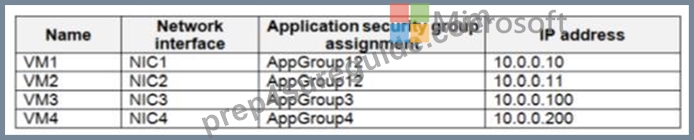
Currently, you have not provisioned any network security groups (NSGs).
You need to implement network security to meet the following requirements:
* Allow traffic to VM4 from VM3 only.
* Allow traffic from the Internet to VM1 and VM2 only.
* Minimize the number of NSGs and network security rules.
How many NSGs and network security rules should you create? To answer, select the appropriate options in the answer area.
NOTE: Each correct selection is worth one point.
Answer:
Explanation:
Explanation
NSGs: 2
Network security rules: 3
Not 2: You cannot specify multiple service tags or application groups) in a security rule.
References:
https://docs.microsoft.com/en-us/azure/virtual-network/security-overview
NEW QUESTION 177
Note: This question is part of a series of questions that present the same scenario. Each question in the series contains a unique solution that might meet the stated goals. Some question sets might have more than one correct solution, while others might not have a correct solution.
After you answer a question in this section, you will NOT be able to return to it. As a result, these questions will not appear in the review screen.
You use Azure Security Center for the centralized policy management of three Azure subscriptions.
You use several policy definitions to manage the security of the subscriptions.
You need to deploy the policy definitions as a group to all three subscriptions.
Solution: You create a policy initiative and an assignment that is scoped to the Tenant Root Group management group.
Does this meet the goal?
- A. No
- B. Yes
Answer: B
Explanation:
Section: [none]
Explanation/Reference:
https://docs.microsoft.com/en-us/azure/governance/policy/overview
https://4sysops.com/archives/apply-governance-policy-to-multiple-azure-subscriptions-with-management- groups/
NEW QUESTION 178
Use the following login credentials as needed:
To enter your username, place your cursor in the Sign in box and click on the username below.
To enter your password, place your cursor in the Enter password box and click on the password below.
Azure Username: [email protected]
Azure Password: Ag1Bh9!#Bd
The following information is for technical support purposes only:
Lab Instance: 10598168


You need to configure Azure to allow RDP connections from the Internet to a virtual machine named VM1.
The solution must minimize the attack surface of VM1.
To complete this task, sign in to the Azure portal.
Answer:
Explanation:
See the explanation below.
Explanation
To enable the RDP port in an NSG, follow these steps:
* Sign in to the Azure portal.
* In Virtual Machines, select VM1
* In Settings, select Networking.
* In Inbound port rules, check whether the port for RDP is set correctly. The following is an example of the configuration:
Priority: 300
Name: Port_3389
Port(Destination): 3389
Protocol: TCP
Source: Any
Destinations: Any
Action: Allow
Reference:
https://docs.microsoft.com/en-us/azure/virtual-machines/troubleshooting/troubleshoot-rdp-nsg-problem
NEW QUESTION 179
......
Structure of AZ-500 Exam
To pass this AZ-500 certification exam, the applicants have to attempt about 40-60 questions within 180 minutes. This test can be taken in the following languages: Japanese, English, Chinese (Simplified), or Korean. The styling of questions considers multiple choices, active screen, build lists, short answer, reviews screen, best answer, and others. The passing score for AZ-500 test is 700 points out of 1000. In order to register, navigate to the Microsoft official website and follow the instructions, which includes paying $165 as the entry fee.
Latest 100% Passing Guarantee - Brilliant AZ-500 Exam Questions PDF: https://www.prep4sureguide.com/AZ-500-prep4sure-exam-guide.html
AZ-500 Certification – Valid Exam Dumps Questions Study Guide: https://drive.google.com/open?id=19881S8AgAXdn9uGjFwQVP5SRt66laBSD