


OmniStudio-Developer Exam Preparation Material with New OmniStudio-Developer Dumps Questions
OmniStudio-Developer 2026 Training With 183 QA's
Salesforce Certified OmniStudio Developer certification is a valuable credential for developers who work with the Salesforce platform. It demonstrates to employers and clients that the individual has the skills and expertise necessary to develop and implement solutions using the OmniStudio platform. Additionally, the certification can help developers advance their careers by opening up new job opportunities and increasing their earning potential.
Salesforce OmniStudio-Developer (Salesforce Certified OmniStudio Developer) Certification Exam is designed for developers who are interested in creating customized solutions using Salesforce's powerful suite of tools. The Salesforce Certified OmniStudio Developer certification is a prestigious and globally recognized certification that validates a developer's expertise in designing and implementing solutions using Salesforce's OmniStudio.
To become certified as a Salesforce Certified OmniStudio Developer, candidates must pass a comprehensive exam that consists of multiple-choice questions and hands-on exercises. OmniStudio-Developer exam is designed to test not only a candidate's knowledge of the OmniStudio platform but also their ability to apply that knowledge to real-world scenarios.
NEW QUESTION # 68
Users receive an APEC CPU limit Exceeded error when running an OmniScript in a Salesfoce Community.
The OmniScript includes an Integration Procedure that contains two DataRaptors.
Which two Location should the developer check to troubleshoot the issue?
Choose 2 answers
- A. Action Debugger
- B. Community logs
- C. DataRaptor configuration
- D. Script configuration
Answer: A,C
Explanation:
According to the Troubleshoot Flow Errors page, one way to troubleshoot errors is to "check the debug logs for the community". Another way is to use the Action Debugger tool, which "lets you test and debug actions in OmniStudio".
NEW QUESTION # 69
A developer examines data received from an external data source. The data is nested two levels down in the JSON structure.
Which OmniStudio tool could the developer use to simplify this data?
- A. Data Mapper Transform
- B. Guided Workflow
- C. Integration Procedure
- D. HTTP Action Element
Answer: C
Explanation:
According to Salesforce OmniStudio Integration Procedures documentation, when working with deeply nested JSON, Integration Procedures are ideal. They allow developers to flatten and manipulate JSON data, especially when handling external responses.
* C. Integration Procedure - This is correct. IPs provide Response Transformers, DataRaptor Transforms, and Response Actions to reshape and simplify nested data structures for consumption by front-end components.
Incorrect Options:
* A. DataRaptor Transform is used inside IPs but cannot directly handle external HTTP calls or manage complex orchestration.
* B. HTTP Action Element is used inside an Integration Procedure, but by itself, it does not process or simplify the data.
* D. Guided Workflow is not a recognized OmniStudio component for data transformation.
OmniStudio Integration Procedures Guide # Handling Nested JSON
NEW QUESTION # 70
A developer needs to build a multi-step intakeform. Each step must allow the user to cancel the intake at any time. The developer is using an LWC OmniScript to build the form.
How should the developer implement the cancel functionality for all steps using the LWC OmniScript Designer?
- A. Check the Enable Cancel checkbox in the Setup tab under Cancel Options.
- B. Add a navigation Action inside each step and set the Component name to ''Cancel'',
- C. Add a navigation Actioninside each step and set the Element Name to ''Cancel'',
- D. Add a navigation Action outside each step and set the Element Name to ''Cancel'',
Answer: A
NEW QUESTION # 71
In an OmnoScript, a developer needs to configure a Disclosureelement to require user input only if the user already checked a Non-Disclosure Agreement Checkbox.
How should the developer configure the conditional view to meet this requirement?
- A. Set element to optional if false
- B. Disable read only if true
- C. Show element if true
- D. Set element to require if true
Answer: D
Explanation:
Explanation
Setting the element to require if true allows the developer to configure a Disclosure element to require user input only if a condition is met. In this case, the condition is that the user already checked a Non-Disclosure Agreement Checkbox. The other options are either incorrect or irrelevant for this requirement.
NEW QUESTION # 72
A developer is troubleshooting an Integration Procedure with two elements: A Remote Action named FetchCart and a Response Action namedResponseCart.
In Preview, what JSON node shows the data sent to the Response Action?
- A. ResponseCart
- B. ResponseCartDebug
- C. FetchCart
- D. Response
Answer: A
Explanation:
Explanation
In Preview, the JSON node that shows the data sent to the Response Action is the name of the Response Action itself. In this case, it is ResponseCart. The other nodes show either the input data or the output data of the Integration Procedure.
NEW QUESTION # 73
Refer to the exhibit below. In this integration production structure, what Send JSON Path would be used to send the Output of the Action1 element to a Remote Action?
- A. Action1. BlockB. Block A
- B. BlockA: BlockB. Action 1
- C. BlockB: BlockB. Action1
- D. Action1: BlockB. Block A
Answer: D
NEW QUESTION # 74
A developer has an existing DataRaptorLoad that insert Contact records with inputs as LastName and firstName. The DataRaptor works as expected when previewed.
The developer creates an integration Procedure to test the DataRaptor and is using a SetValues element in the Integration Procedure toset the first name and last name for the contact record. The DataRaptor and Integration Procedure are set up as shown in the exhibit below.
When the developer executes the Integration procedure in preview, the following error message displays:
Required fields are missing: [last Name]'',
How should the developer address this issue?
- A. SetValuesContactDetails should have been added to Additional input of DataRaptor Post Action in Integration Procedure
- B. The DataRaptor Post Action in the integration procedure should have been executed before the Set Values Action
- C. The Set values Action Keys should include the DataRaptor Post Action element name path, e,g LoadContactDetails, lastname
- D. The valid field names should be added in the Domain object field in theDataRaptor
Answer: A
Explanation:
According to the Integration Procedure Actions page, "To pass data from a Set Values action to a DataRaptor action, add the Set Values action name to the Additional Input field of the DataRaptor action."
NEW QUESTION # 75
Refer to the exhibit.
All inputs to the Calculation Matric are set correctly.
The Calculation Matrix has the following input:
What is the output?
- A. 12.99
- B. 12.99,13.99
- C. 13.99
- D. Null
Answer: C
NEW QUESTION # 76
An OmniStudio Developer is defining a formula in a Data Mapper to create a unique external identifier that combines the AccountName and the current DateTime. The formula output must be set as a new variable in the Data Mapper ' s JSON. What is the essential final step after defining the formula?
- A. Map the formula result to a target field in the Transform tab.
- B. Map the formula result to a target field in the Extract tab.
- C. Map the formula result to a target field in the Mapping tab.
- D. Map the formula to an output field in the Output tab.
Answer: C
Explanation:
After defining a formula, the result must be stored and made available in the Data Mapper output structure. In the current Data Mapper design pattern, the formula result path creates a JSON node, and the developer then maps that result into the final output through the mapping configuration. This is why option B is the best answer: the formula is not useful to downstream actions until it is mapped to the required target output. The Extract tab is used to define source data retrieval, not to map formula results. The Output tab applies to specific Extract-style mappings in older terminology, but the question uses the generic Data Mapper mapping workflow. The essential step is to map the formula result into the JSON.
NEW QUESTION # 77
An OmniScript updates data from one Salesforce record, but when it completes, only some of the data is updated in Salesforce. A DataRaptor Load saves the data.
What error could cause this behavior? Choose 2 answers Calculator
- A. Contextid is misspelled in the merge code that passes the Recordid fo the DataRaptor.
- B. The Input JSON paths in the DataRaptor Load do noi match the JSON sent from the OmniScript.
- C. In the DataRapior Load, in the preview tab, the Recordid is from the wrong record type. a
- D. The fields that are not updated are read only in Salesforce.
Answer: B,D
NEW QUESTION # 78
A customer sets up to LWC Omniscripts, one embedded into another. Account is set in a Set Values element in the parent Omniscript.
The AccountId set in the parent Omniscript is used to another Set Values element ContextAccountid in the embedded OmniScript. The embedded Omniscript is activated.
While previewing the OmniScript flow from the parent, it is found that Account is set correctly in the parent OmniScript. However. ContextAccountId in the embedded OmniScript is not set with theAccountId from parent Omniscript. On previewing the embedded OmniScript individually, it is found that ContextAccountId isset correctly.
What is the reason for this? Refer to the exhibit below.

- A. A developer failed to include a Navigation Element to pass data from the parent OmniScript.
- B. The LWC PubSub Message flag in the Set Values action of the parent has not been set.
- C. The flag passDataJSON in the parent OmniScript in not configured correctly.
- D. Both parent and embedded OmniScripts have the same element name for the Set values element.
Answer: A
Explanation:
Explanation
The LWC PubSub Message flag in the Set Values action of the parent OmniScript enables the parent OmniScript to send data to the embedded OmniScript using a custom event. If this flag is not set, the data will not be passed to the embedded OmniScript.
NEW QUESTION # 79
Refer to the exhibit.
All inputs to the Calculation Matric are set correctly.
The Calculation Matrix has the following input:
What is the output?
- A. 12.99
- B. 12.99,13.99
- C. 13.99
- D. Null
Answer: C
Explanation:
According to the Calculation Matrix Overview page, a Calculation Matrix is "a lookup table that takes an input and returns an output". In this case, the input is the ProductCode and the output is the Price. The exhibit shows a Calculation Matrix with four rows, each with a different ProductCode and Price. The input given is ProductCode: HRA3320, which matches the second row of the matrix. Therefore, the output is Price: 13.99, which is the value in the same row.
NEW QUESTION # 80
Which JSON from the DRGetAccountDetails action would display all six values correctly in the Omniscript structure shown?
BlkContacts is a Repeat Block.

- A. Option D
- B. Option A
- C. Option B
- D. Option C
Answer: B
Explanation:
From the OmniStudio OmniScript Documentation:
* A Repeat Block (like BlkContacts) expects an array of objects.
* Each item in the array must contain fields that exactly match the UI elements inside the block.
* The parent JSON must include any top-level values used by individual input fields (like AccountName, AccountPhone).
Why the Other Options Are Incorrect:
* B. Uses Contacts instead of BlkContacts, and is incomplete/malformed.
* C. Repeats keys at the same level instead of using an array structure. This causes the data to overwrite and fail to display properly.
* D. Uses incorrect keys like "Name" and "Phone" instead of expected "ContactName" and
"ContactPhone", breaking field binding.
Reference:
Salesforce OmniStudio Developer Guide # OmniScript Repeat Blocks & Data JSON Structure DataRaptor Extract Output # Mapping JSON for OmniScripts
NEW QUESTION # 81
An OmniStudio Developer attempts to deploy an Integration Procedure that calls a Remote Action Apex class. The deployment fails because the Apex class dependency is not found. What is the required action the developer must take?
- A. Configure the Integration Procedure with a Try-Catch Block.
- B. Deploy the Apex class to the target environment before deploying the Integration Procedure.
- C. Configure the Integration Procedure with a Cache Duration.
- D. Configure the Integration Procedure as Chainable.
Answer: B
Explanation:
An Integration Procedure that calls a Remote Action depends on the referenced Apex class existing in the target org. If the Apex class is missing, the Integration Procedure cannot resolve that dependency during deployment or execution. The required fix is to deploy the Apex class first, then deploy the Integration Procedure that references it. Cache Duration has no relationship to metadata dependency resolution.
Chainable configuration controls long-running transaction behavior and governor-limit handling, not missing Apex metadata. A Try-Catch Block can help handle runtime failures, but it does not solve a deployment failure caused by an absent Apex class. Salesforce's OmniStudio deployment guidance specifically includes considerations for Apex class checks and dependencies when deploying Integration Procedures.
NEW QUESTION # 82
Refer to the exhibit.
What JSON code correct represent the step in the OmniScript Structure panel shown?
A)
B)
C)
D)
- A. Option D
- B. Option A
- C. Option B
- D. Option C
Answer: D
NEW QUESTION # 83
A developer needs to configure a DataRaptor to retrieve data from a singleobject. Thestructure of the output data does not need to be changed.
Following best practices, which type of DataRaptor should the developer use?
- A. DataRaptor Turbo Extract
- B. DataRaptor Extract
- C. DataRaptor Load
- D. DataRaptor Transform
Answer: A
Explanation:
A DataRaptor Turbo Extract is a simplified version of a DataRaptor Extract that can retrieve data from a single object without changing the structure of the output data. It is suitable for this scenario because the developer does not need to transform or load the data
NEW QUESTION # 84
Which two fields in an Integration Procedure or Data Mapper can execute a function like CONCAT or DATEDIFF?
Choose 2 answers
- A. In a Remote Action in an Additional Output value field
- B. In a Data Mapper in an Output Tab Output JSON Path
- C. In a Data Mapper Action in an Input Parameters value field
- D. In a Set Values Action in a Value field
Answer: C,D
Explanation:
Functions like CONCAT, DATEDIFF, and IF are supported in value fields where expressions can be parsed at runtime.
* B. In a Set Values Action in a Value field - Correct. The Set Values element supports expression functions in its Value field, allowing for real-time evaluation during IP execution.
* C. In a Data Mapper Action in an Input Parameters value field - Correct. Input Parameters to DataRaptors in Integration Procedures can use expression logic to dynamically compute and pass values.
Incorrect Options:
* A. Output JSON Path in DataRaptor is for structural mapping, not function execution.
* D. Remote Action Output fields typically receive data, not compute it.
Salesforce OmniStudio Developer Guide # Expression Functions in Integration Procedures
NEW QUESTION # 85
A developer creates a Flexcardthat displaysa contact's mailing address and passes the contact's postal code to a child FlexCard.
When configuration text elements in the child FlexCard, what syntax should a developer use to refer to the contact's postal code?
- A. {Postalcode}
- B. {Records.postalcode}
- C. {Params.postalcode}
- D. {Parent.postalcode}
Answer: C
Explanation:
Explanation
The Params node contains the data that is passed from the parent FlexCard to the child FlexCard. The developer should use {Params.postalcode} to refer to the contact's postal code in the child FlexCard.
NEW QUESTION # 86
A developer creates a DataRaptor Extract to retrieve data to pass toan externalservice. The external service expects the field value to beaninteger. However, the DataRaptor is sending it as a string.
Which action can the developer take to fix this?
- A. In the DataRaptor Formula tab, define a formula using the function TOINTEGER and usethe formulaas output.
- B. In the DataRaptor Output tab, enter the default value as 0 on the field.
- C. In the DataRaptor Output tab, select the Output Data Type of that field toInteger.
- D. In the DataRaptor Extract tab, set the Input Data Type field to Integer.
Answer: A
Explanation:
The DataRaptor Formula tab allows the developer to define formulas using functions and operators to manipulate data. The TOINTEGER function converts a string value to an integer value. The developer can use this function to output the field value as an integer and use the formula as output
NEW QUESTION # 87
A developer creates an OmniScript to update billing information. After analyzing the different types of customer interactions that occur at the company, the developer determines updating billing information should be included in the majority of customer interactions, which are represented by more than 20 different FlexCards.
What is the most efficient way for the developer to configure the action that invokes the OmniScript?
- A. As a Lightning Action
- B. As an OS Action
- C. As an OmniStudio Action
- D. As a Custom Action
Answer: C
NEW QUESTION # 88
A developer creates a Flexcard that displays a contact's mailing address and passes the contact's postal code to a child FlexCard.
When configuration text elements in the child FlexCard, what syntax should a developer use to refer to the contact's postal code?
- A. {Postalcode}
- B. {Records.postalcode}
- C. {Params.postalcode}
- D. {Parent.postalcode}
Answer: C
NEW QUESTION # 89
When deploying OmniStudio components using the Vlocity Build Tool, what is the typical file format that contains the metadata and definition for a component like a Data Mapper?
- A. DOCX
- B. JSON
- C. XML
- D. CSV
Answer: B
Explanation:
The correct answer is JSON. Vlocity Build Tool, also called the OmniStudio Build Tool in newer documentation, exports and deploys OmniStudio/Vlocity DataPacks in a source-control-friendly structure. A Data Mapper, FlexCard, OmniScript, or Integration Procedure is represented as DataPack metadata, and the component definition is stored in JSON-based files, while job or manifest configuration can use YAML.
DOCX is a document format and has no role in OmniStudio deployment metadata. CSV can hold tabular data, not a full component definition. XML is used in some Salesforce metadata contexts, but DataPacks for OmniStudio deployment are not typically represented as XML component files. Therefore, JSON is the correct deployment metadata format.
NEW QUESTION # 90
A developer configure a Flexcard with a DataRaptor data source that uses the params.id as an. When the developer clicks Views Data on the FlexCard, valid data displays. However, when the developer previews the layout, the FlexCard does not display. What could cause this error?
Choose 2 answers
- A. The Data Node field for the FlexCard is empty.
- B. There is not Salesforce record for the FlexCard based on the RecordId in the layout's Test Data Source Settings.
- C. The attribute haven't been configured to pass the data to the fields.
- D. The RecordId in the Test Data Source settings ins for the wrong record type.
Answer: C,D
NEW QUESTION # 91
You want a child FlexCard to use the parent's data source.
What do you need to do to make it work? Choose 2 answers
- A. The same fields must be available in both parent and child FlexCards
- B. You must select a data node in the Data Node field in the Properties panel on the child FlexCard Pencil & Pape
- C. The same data source must be selected and configured in both parent and child FlexCards
- D. You must select a data node in the Data Node field in the Properties panel on the parent FlexCard
Answer: B,D
NEW QUESTION # 92
A developer is creating an OmniScript that provisions trail orgs to their customers. The following text block in the Omniscript uses a merge code to display the ID for the new trail org: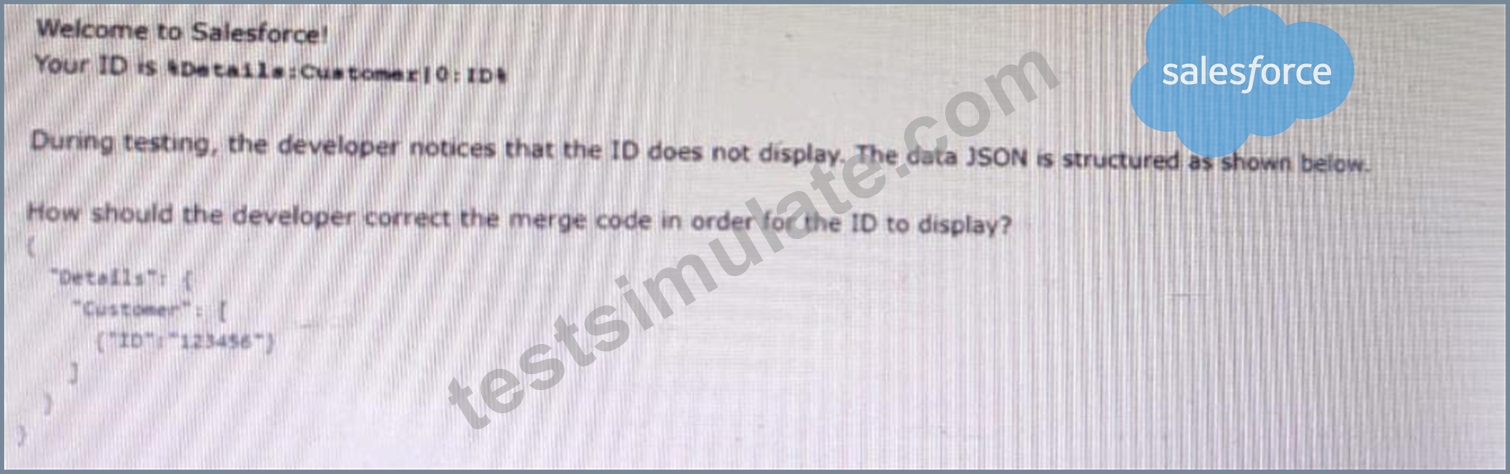
- A. To %Details: Customer|1: ID%
- B. To %sDetails: Customer|0: ID$
- C. To %%sDetails: Customer|0: ID%%
- D. To %Details: Customer|n: ID%
Answer: A
NEW QUESTION # 93
......
Quickly and Easily Pass Salesforce Exam with OmniStudio-Developer real Dumps: https://www.prep4sureguide.com/OmniStudio-Developer-prep4sure-exam-guide.html
Salesforce OmniStudio-Developer Certification Exam Questions: https://drive.google.com/open?id=1ViEq9JOLTLELdVE-91GX-s1h9mKRemlU