


JN0-452 Exam Dumps Pass with Updated 2026 Certified Exam Questions
JN0-452 Exam Questions - Real & Updated Questions PDF
NEW QUESTION # 48
Marvis Minis verifies possible network problems in which order?
- A. Application, DNS, ARP, DHCP
- B. DNS, DHCP, ARP, application
- C. DHCP, ARP, DNS, application
- D. ARP, application, DNS, DHCP
Answer: C
Explanation:
InJuniper Networks Mist AI Wireless,Marvis Minisare purpose-built synthetic clients designed to proactively validate end-user experience by continuously testing the network in the same way a real user device would. To accurately isolate the root cause of connectivity or performance issues, Marvis Minis follow astrict, layered verification sequencethat mirrors the logical dependency of network services.
The verification process begins withDHCP. This is the foundational step because, without a valid IP address, no further network communication can occur. Marvis Minis first confirm that the client can successfully complete the DHCP exchange and obtain proper IP configuration, including subnet, gateway, and lease parameters.
Once DHCP is validated, Marvis Minis move toARPverification. At this stage, the synthetic client confirms it can resolve the MAC address of the default gateway and communicate at Layer 2. ARP issues can prevent traffic from leaving the local network segment even when an IP address is present.
After Layer 2 and Layer 3 reachability are confirmed, Marvis Minis testDNSfunctionality. DNS resolution is critical for application access, as most modern applications rely on hostname resolution rather than raw IP addresses. Failed or slow DNS responses are a common cause of perceived "application outages." Finally, Marvis Minis validate theapplication layer. This includes testing reachability, response time, and success of specific application transactions such as HTTPS connections, SaaS access, or internal application availability. By the time application testing occurs, all prerequisite network services have already been verified.
The other options are incorrect because they test higher-layer services before validating lower-layer dependencies, which can lead to misleading conclusions. Mist's ordered approach-DHCP # ARP # DNS # Application-ensures precise fault isolation and actionable insights, allowing Marvis AI to accurately pinpoint where the user experience is breaking down.
NEW QUESTION # 49
Which two statements are correct about channel bonding? (Choose two.)
- A. Bonding two channels together doubles the available bandwidth.
- B. Bonding two channels together doubles the noise floor.
- C. Bonding two channels together doubles the number of available channels.
- D. Bonding two channels together doubles the required device resources.
Answer: A,B
Explanation:
Reference: https://www.makeuseof.com/tag/internet-speed-channel-bonding/
NEW QUESTION # 50
Regarding the seven-layer OSI networking model, which two layers are different between Ethernet and Wi-Fi? (Choose two.)
- A. logical link control (LLC) sub-layer
- B. network layer
- C. physical layer
- D. media access control (MAC) sub-layer
Answer: C,D
NEW QUESTION # 51
You are asked to clone your Juniper Mist primary site configuration to use for a new site being added. In this scenario, which two configuration objects will be copied? (Choose two.)
- A. the WLANs
- B. the site location
- C. the RF templates
- D. the Auto Firmware Upgrade settings
Answer: C,D
Explanation:
The Clone Site feature in the Juniper Mist dashboard is a powerful tool designed to streamline the deployment of new physical locations by duplicating the environmental and operational logic of an existing
"gold standard" site. However, to avoid configuration conflicts (such as duplicate addresses) and to maintain the integrity of the hierarchy, Mist is selective about which objects are carried over during the cloning process.
According to Juniper Mist documentation, only the settings visible on the Site Configuration page are copied to the new site. This specifically includes:
* Auto Firmware Upgrade settings (A): The specific versioning (Production vs. RC) and the weekly or daily maintenance windows defined for the site are preserved. This ensures that the new site follows the same lifecycle management policy as the primary site.
* RF Templates (B): The radio resource management (RRM) profile assigned to the site is copied. This includes channel planning, bandwidth settings (20/40/80 MHz), and power level constraints tailored for that environment.
* Other Site-Level Settings: This also includes Webhooks, Rogue/Honeypot AP detection rules, and Location Services settings.
Conversely, certain objects are explicitly not copied. The Site Location (C) and Site Name are excluded because each site must be geographically unique for accurate mapping and time zone calculation. WLANs (D) are also not copied through the Clone Site function; SSIDs are typically managed at the Organization level via WLAN Templates, which are then mapped to sites or site groups rather than being "hardcoded" into an individual site's local configuration. By cloning the site-specific parameters like RF templates and upgrade schedules, Mist allows administrators to rapidly scale their infrastructure while ensuring the core network access (WLANs) is maintained through the overarching organizational policy.
NEW QUESTION # 52
RF templates are assigned to which Mist configuration object?
- A. sites
- B. WLANs
- C. site groups
- D. config templates
Answer: D
NEW QUESTION # 53
Click the Exhibit button.
A user opened a ticket. Upon troubleshooting, you determine that frequent roaming is the root cause of the problem.
Referring to the exhibit, which statement describes the roaming issue that the client is experiencing?
- A. There are frequent roams between different WLANs.
- B. There are frequent roams between different protocols.
- C. There are frequent roams between different bands.
- D. There are frequent roams between different access points.
Answer: D
Explanation:
The exhibit shows a graph of the client's roaming history over time. The x-axis represents the time and the y- axis represents the access point ID. Each dot on the graph indicates a roam event where the client switched from one access point to another.
The graph shows that the client roamed between different access points multiple times within a short period of time. This indicates that the client was experiencing frequent roams between different access points, which could affect its network performance and user experience.
NEW QUESTION # 54
An administrator has configured a Mist Tunnel at the organization level, defining a primary and a secondary Mist Edge cluster for redundancy. They now need to apply this tunneled configuration to a specific corporate WLAN.
Where in the Mist UI is the Mist Tunnel object associated with the WLAN? (Choose 2.)
- A. In the WLAN configuration, under the "Custom Forwarding" section.
- B. In a WLAN Template that is applied to the site.
- C. In the Device Profile for the access points.
- D. In the Site Settings under "Mist Tunnels".
- E. In the RF Template under "Tunnel Settings".
Answer: A,B
NEW QUESTION # 55
Which Service Level Expectation (SLE) specifically measures the success rate of clients passing the initial 802.11 association frame exchange with an access point?
- A. Roaming
- B. Coverage
- C. Successful Connects
- D. Time to Connect
Answer: C
NEW QUESTION # 56
Which two statements are correct about Juniper Mist Dynamic Packet Capture? (Choose two.)
- A. It must be globally configured at the organization level.
- B. It is automatically attached to a client event displayed on the Insights page.
- C. No configuration is necessary for Mist's Dynamic Packet Capture.
- D. It is automatically attached to the Affected Items list in the Successful Connects SLE.
Answer: B,C
Explanation:
Two correct statements about Juniper Mist Dynamic Packet Capture are that no configuration is necessary for Mist's Dynamic Packet Capture and it is automatically attached to a client event displayed on the Insights page. So the correct answers are A. No configuration is necessary for Mist's Dynamic Packet Capture and B.
It is automatically attached to a client event displayed on the Insights page.
NEW QUESTION # 57
Which pair of Wireless Assurance SLEs have a classifier on DHCP?
- A. Roaming and Coverage
- B. Successful Connects and Time to Connect
- C. Time to Connect and Roaming
- D. Coverage and Throughput
Answer: B
Explanation:
InJuniper Networks Mist AI Wireless, Service Level Expectations (SLEs) are used to measure and assure real user experience across the wireless network. Each SLE is built on specificclassifiers, which break down failures into root causes such as DHCP, DNS, authentication, RF conditions, or application issues.
Understanding which SLEs rely on DHCP classification is essential for accurate troubleshooting.
The two Wireless Assurance SLEs that include aDHCP classifierareSuccessful ConnectsandTime to Connect.
TheSuccessful Connects SLEmeasures whether client devices are able to complete the full connection process successfully. This process includes association, authentication, and critically,DHCP address assignment. If a client fails to obtain an IP address, the connection is considered unsuccessful, and the failure is explicitly classified as a DHCP issue within this SLE.
TheTime to Connect SLEmeasures how long it takes for a client to connect from the moment it initiates association until it is fully usable on the network. One of the key components of this timeline is theDHCP transaction time. Slow DHCP responses, retransmissions, or server delays directly increase the overall connection time, and Mist classifies these delays under DHCP within the Time to Connect SLE.
The other options are incorrect for the following reasons:
* Roaming SLEfocuses on re-association, authentication, and mobility events, not DHCP, since IP addressing is typically retained during roaming.
* Coverage SLEevaluates RF signal strength, SNR, and cell overlap, with no dependency on DHCP.
* Throughput SLEmeasures data transfer performance after connectivity is established and does not analyze DHCP behavior.
Therefore, the correct answer isSuccessful Connects and Time to Connect, as both SLEs directly depend on and classifyDHCP-related performance and failureswithin Mist Wireless Assurance.
NEW QUESTION # 58
Which signal modulation scheme provides the highest data rate level for 802.11ax devices?
- A. 4096 QAM
- B. 256 QAM
- C. 1024 QAM
- D. 64 QAM
Answer: C
Explanation:
InJuniper Networks Mist AI Wireless, understanding modulation schemes is essential for designing and operating high-performance Wi-Fi 6 (802.11ax) networks. Modulation directly affects how much data can be transmitted per symbol, and therefore determines the maximum achievable data rates under optimal RF conditions.
802.11ax introduces 1024-QAM (Quadrature Amplitude Modulation)as its highest supported modulation scheme. With 1024-QAM, each symbol encodes10 bits of data, which represents a significant increase compared to earlier standards. For reference:
* 64-QAM (used in earlier standards) carries 6 bits per symbol
* 256-QAM (introduced in 802.11ac) carries 8 bits per symbol
* 1024-QAM increases this to 10 bits per symbol
This higher bit density allows Wi-Fi 6 devices to achievehigher peak throughput, especially in environments with excellent signal quality. However, 1024-QAM requiresvery high Signal-to-Noise Ratio (SNR)and low interference to function reliably. As a result, it is typically achieved only when clients are close to the access point and RF conditions are clean.
Mist AI Wireless continuously monitors client RSSI, SNR, retransmissions, and modulation rates through advanced telemetry. Using this data, Mist can determine whether clients are successfully operating at higher modulation levels like 1024-QAM or are falling back to lower schemes due to RF impairments. This insight directly feeds into SLEs and AI-driven recommendations for RF tuning, AP placement, and channel planning.
The incorrect options are explained as follows:
* 64-QAMand256-QAMare valid modulation schemes but do not provide the highest data rates in 802.11 ax.
* 4096-QAMis not supported by the 802.11ax standard and is therefore invalid.
Thus,1024-QAMis the modulation scheme that provides thehighest data rate level for 802.11ax devices.
NEW QUESTION # 59
Which Juniper Mist LBS feature would be used to create a historical heatmap of visitor traffic patterns throughout a retail store?
- A. Asset Visibility
- B. User Engagement (via Zone Occupancy Analytics)
- C. vBLE Beacons
- D. Proximity Tracing
Answer: B
NEW QUESTION # 60
What does Mist's patented 16-element vBLE Antenna Array do when "engagement" is enabled?
- A. locates Wi-Fi assets
- B. transmits unique and directional BLE beams
- C. performs radio resource management
- D. performs personal pre-shared key sharing
Answer: B
Explanation:
Reference: https://www.mist.com/resources/ap61-access-point/
NEW QUESTION # 61
A helpdesk technician is unable to resolve an AP connectivity issue and decides to replace the faulty AP with a new one. The goal is to have the new AP adopt the exact same configuration as the old one, including its name, site assignment, and any device-level overrides, with minimal manual effort. What is the most efficient procedure in the Mist UI to accomplish this?
- A. Delete the old AP from the dashboard, then claim the new AP using the same name as the old one.
- B. On the old AP's configuration page, select "Replace AP" from the Utilities menu and enter the claim code or MAC address of the new, unclaimed AP.
- C. Create a Device Profile from the old AP's configuration and apply it to the new AP after it has been claimed and assigned to the site.
- D. Claim the new AP, assign it to the site, then manually copy all settings from the old AP's configuration page to the new AP's page.
Answer: B
NEW QUESTION # 62
An administrator is setting up a new site and has created a WLAN Template containing the standard corporate and guest SSIDs. This template is applied to the entire organization.
However, for this new site only, the guest network must be disabled.
What is the most efficient way to achieve this without creating a new WLAN Template?
- A. Create a Device Profile for the APs at the new site and disable the guest WLAN within the profile.
- B. At the new site, go to Site > WLANs, select the guest WLAN inherited from the template, and disable it.
- C. In the WLAN Template, create an exception for the new site under the guest WLAN's configuration.
- D. At the new site, go to Site > WLANs and create a new WLAN with the same guest SSID, but leave it disabled.
Answer: D
NEW QUESTION # 63
Referring to the exhibit, what are two reasons why a Mist AP would have multiple IP addresses? (Choose two.)
- A. One IP address is used for redundancy.
- B. One IP address is used for control traffic and one address is used for management traffic.
- C. The Local Status Page is enabled in the site settings.
- D. A guest portal is configured on a tagged VLAN.
Answer: C,D
Explanation:
Reference: https://www.mist.com/documentation/aps-use-ip-addresses/
According to the Mist AP43 Access Point Data Sheet document1 and the Guest Access - Mist document2, two reasons why a Mist AP would have multiple IP addresses are:
The Local Status Page is enabled in the site settings, which allows the AP to have an additional IP address on VLAN 4094 for local management purposes.
A guest portal is configured on a tagged VLAN, which allows the AP to have an additional IP address on that VLAN for guest access purposes.
References: https://www.mist.com/wp-content/uploads/Mist-AP43-Data-Sheet.pdf https://www.mist.com
/documentation/guest-access/
NEW QUESTION # 64
Click the Exhibit button.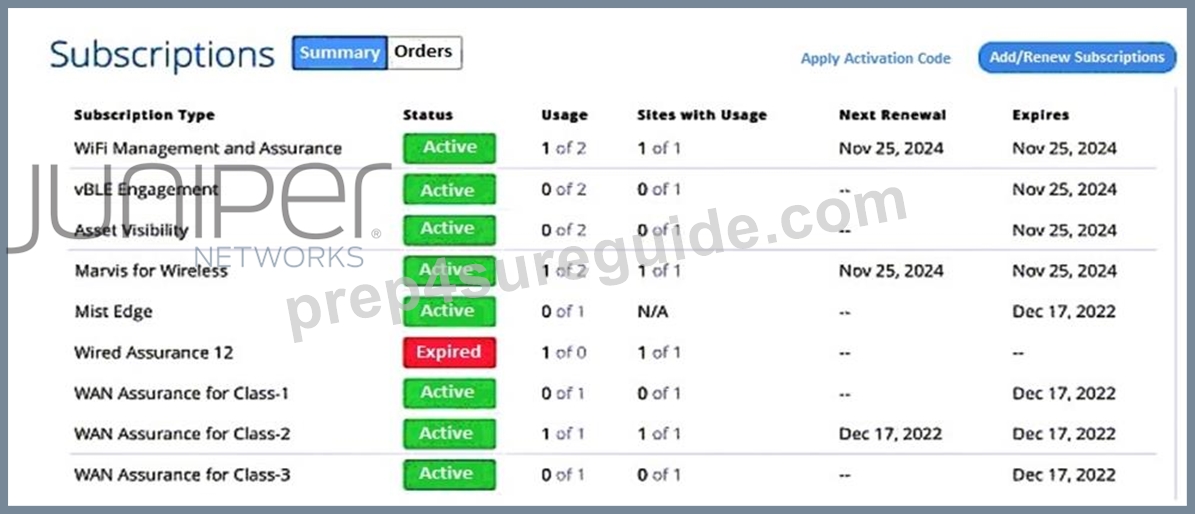
Referring to the exhibit, which two statements are correct? (Choose two.)
- A. The organization is using one license for Marvis wireless.
- B. The organization has two available licenses for Marvis wireless.
- C. The organization is using two licenses for Marvis wireless.
- D. The organization has one available license for Marvis wireless.
Answer: A,D
Explanation:
According to the exhibit, the organization has a total of two licenses for Marvis wireless, and one of them is in use. Therefore, the organization has one available license and one used license for Marvis wireless.
NEW QUESTION # 65
What is the fundamental architectural principle of Juniper Mist that distinguishes it from legacy controller-based WLAN systems?
- A. Firmware updates for access points and configuration changes are pushed from an on-premises controller appliance.
- B. All user data traffic is required to be backhauled to the Juniper Mist cloud for processing and security inspection.
- C. All access points must first be provisioned through a CLI before connecting to the cloud.
- D. It uses a microservices cloud for management and control, while the data plane can be handled either locally at the AP or centrally via Mist Edge.
Answer: D
NEW QUESTION # 66
......
Pass Guaranteed Quiz 2026 Realistic Verified Free Juniper: https://www.prep4sureguide.com/JN0-452-prep4sure-exam-guide.html
Free JNCIS MistAI Wireless JN0-452 Ultimate Study Guide: https://drive.google.com/open?id=1zsX8GPC3O5fnVrdmZXl8OUTWU4QrmGCG