


DP-203 Questions Prepare with Learning Information! 2024 Regularly updated
Get DP-203 Products Practice Material for DP-203 Exam Question Preparation
Microsoft DP-203 certification exam is ideal for data engineers, data architects, and data professionals who want to expand their skill set and enhance their career prospects. Data Engineering on Microsoft Azure certification is also suitable for IT professionals who want to transition into the field of data engineering on Azure. DP-203 exam is intended for candidates who have a solid understanding of data concepts and have experience working with data solutions on Azure.
The DP-203 certification is particularly valuable for data engineers, data architects, and other professionals who work with data on the Azure platform. This credential can help individuals advance their careers by demonstrating their expertise in this in-demand field. Additionally, the DP-203 certification can give organizations confidence in the abilities of their data professionals, helping to improve the quality of data engineering projects and initiatives.
The DP-203 exam covers a wide range of topics related to data engineering on Azure, including data ingestion and processing, data storage, data transformation, and data security. Candidates are expected to have a deep understanding of Azure services, such as Azure Data Factory, Azure Databricks, Azure Stream Analytics, and Azure Synapse Analytics, as well as knowledge of programming languages such as SQL, Python, and Scala.
NEW QUESTION # 185
You build a data warehouse in an Azure Synapse Analytics dedicated SQL pool.
Analysts write a complex SELECT query that contains multiple JOIN and CASE statements to transform data for use in inventory reports. The inventory reports will use the data and additional WHERE parameters depending on the report. The reports will be produced once daily.
You need to implement a solution to make the dataset available for the reports. The solution must minimize query times.
What should you implement?
- A. a materialized view
- B. in ordered clustered columnstore index
- C. result set chaching
- D. a replicated table
Answer: A
Explanation:
Explanation
Materialized views for dedicated SQL pools in Azure Synapse provide a low maintenance method for complex analytical queries to get fast performance without any query change.
Note: When result set caching is enabled, dedicated SQL pool automatically caches query results in the user database for repetitive use. This allows subsequent query executions to get results directly from the persisted cache so recomputation is not needed. Result set caching improves query performance and reduces compute resource usage. In addition, queries using cached results set do not use any concurrency slots and thus do not count against existing concurrency limits.
Reference:
https://docs.microsoft.com/en-us/azure/synapse-analytics/sql-data-warehouse/performance-tuning-materialized-v
https://docs.microsoft.com/en-us/azure/synapse-analytics/sql-data-warehouse/performance-tuning-result-set-cach
NEW QUESTION # 186
You have an Azure Synapse Analytics job that uses Scala.
You need to view the status of the job.
What should you do?
- A. From Synapse Studio, select the workspace. From Monitor, select SQL requests.
- B. From Azure Monitor, run a Kusto query against the SparkLogying1 Event.CL table.
- C. From Synapse Studio, select the workspace. From Monitor, select Apache Sparks applications.
- D. From Azure Monitor, run a Kusto query against the AzureDiagnostics table.
Answer: C
Explanation:
Explanation
Use Synapse Studio to monitor your Apache Spark applications. To monitor running Apache Spark application Open Monitor, then select Apache Spark applications. To view the details about the Apache Spark applications that are running, select the submitting Apache Spark application and view the details. If the Apache Spark application is still running, you can monitor the progress.
Reference:
https://docs.microsoft.com/en-us/azure/synapse-analytics/monitoring/apache-spark-applications
NEW QUESTION # 187
You are building an Azure Stream Analytics job to identify how much time a user spends interacting with a feature on a webpage.
The job receives events based on user actions on the webpage. Each row of data represents an event. Each event has a type of either 'start' or 'end'.
You need to calculate the duration between start and end events.
How should you complete the query? To answer, select the appropriate options in the answer area.
NOTE: Each correct selection is worth one point.
Answer:
Explanation:
Explanation
Box 1: DATEDIFF
DATEDIFF function returns the count (as a signed integer value) of the specified datepart boundaries crossed between the specified startdate and enddate.
Syntax: DATEDIFF ( datepart , startdate, enddate )
Box 2: LAST
The LAST function can be used to retrieve the last event within a specific condition. In this example, the condition is an event of type Start, partitioning the search by PARTITION BY user and feature. This way, every user and feature is treated independently when searching for the Start event. LIMIT DURATION limits the search back in time to 1 hour between the End and Start events.
Example:
SELECT
[user],
feature,
DATEDIFF(
second,
LAST(Time) OVER (PARTITION BY [user], feature LIMIT DURATION(hour,
1) WHEN Event = 'start'),
Time) as duration
FROM input TIMESTAMP BY Time
WHERE
Event = 'end'
Reference:
https://docs.microsoft.com/en-us/azure/stream-analytics/stream-analytics-stream-analytics-query-patterns
NEW QUESTION # 188
You need to design a data retention solution for the Twitter teed data records. The solution must meet the customer sentiment analytics requirements.
Which Azure Storage functionality should you include in the solution?
- A. time-based retention
- B. Iifecycle management
- C. soft delete
- D. change feed
Answer: B
Explanation:
Topic 2, Litware, inc.
Case study
This is a case study. Case studies are not timed separately. You can use as much exam time as you would like to complete each case. However, there may be additional case studies and sections on this exam. You must manage your time to ensure that you are able to complete all questions included on this exam in the time provided.
To answer the questions included in a case study, you will need to reference information that is provided in the case study. Case studies might contain exhibits and other resources that provide more information about the scenario that is described in the case study. Each question is independent of the other questions in this case study.
At the end of this case study, a review screen will appear. This screen allows you to review your answers and to make changes before you move to the next section of the exam. After you begin a new section, you cannot return to this section.
To start the case study
To display the first question in this case study, click the button. Use the buttons in the left pane to explore the content of the case study before you answer the questions. Clicking these buttons displays information such as business requirements, existing environment, and problem statements. If the case study has an All Information tab, note that the information displayed is identical to the information displayed on the subsequent tabs. When you are ready to answer a question, click the button to return to the question.
Overview
Litware, Inc. owns and operates 300 convenience stores across the US. The company sells a variety of packaged foods and drinks, as well as a variety of prepared foods, such as sandwiches and pizzas.
Litware has a loyalty club whereby members can get daily discounts on specific items by providing their membership number at checkout.
Litware employs business analysts who prefer to analyze data by using Microsoft Power BI, and data scientists who prefer analyzing data in Azure Databricks notebooks.
Requirements
Business Goals
Litware wants to create a new analytics environment in Azure to meet the following requirements:
* See inventory levels across the stores. Data must be updated as close to real time as possible.
* Execute ad hoc analytical queries on historical data to identify whether the loyalty club discounts increase sales of the discounted products.
* Every four hours, notify store employees about how many prepared food items to produce based on historical demand from the sales data.
Technical Requirements
Litware identifies the following technical requirements:
* Minimize the number of different Azure services needed to achieve the business goals.
* Use platform as a service (PaaS) offerings whenever possible and avoid having to provision virtual machines that must be managed by Litware.
* Ensure that the analytical data store is accessible only to the company's on-premises network and Azure services.
* Use Azure Active Directory (Azure AD) authentication whenever possible.
* Use the principle of least privilege when designing security.
* Stage Inventory data in Azure Data Lake Storage Gen2 before loading the data into the analytical data store. Litware wants to remove transient data from Data Lake Storage once the data is no longer in use.
Files that have a modified date that is older than 14 days must be removed.
* Limit the business analysts' access to customer contact information, such as phone numbers, because this type of data is not analytically relevant.
* Ensure that you can quickly restore a copy of the analytical data store within one hour in the event of corruption or accidental deletion.
Planned Environment
Litware plans to implement the following environment:
* The application development team will create an Azure event hub to receive real-time sales data, including store number, date, time, product ID, customer loyalty number, price, and discount amount, from the point of sale (POS) system and output the data to data storage in Azure.
* Customer data, including name, contact information, and loyalty number, comes from Salesforce, a SaaS application, and can be imported into Azure once every eight hours. Row modified dates are not trusted in the source table.
* Product data, including product ID, name, and category, comes from Salesforce and can be imported into Azure once every eight hours. Row modified dates are not trusted in the source table.
* Daily inventory data comes from a Microsoft SQL server located on a private network.
* Litware currently has 5 TB of historical sales data and 100 GB of customer data. The company expects approximately 100 GB of new data per month for the next year.
* Litware will build a custom application named FoodPrep to provide store employees with the calculation results of how many prepared food items to produce every four hours.
* Litware does not plan to implement Azure ExpressRoute or a VPN between the on-premises network and Azure.
NEW QUESTION # 189
You are creating dimensions for a data warehouse in an Azure Synapse Analytics dedicated SQL pool.
You create a table by using the Transact-SQL statement shown in the following exhibit.
Use the drop-down menus to select the answer choice that completes each statement based on the information presented in the graphic.
NOTE: Each correct selection is worth one point.
Answer:
Explanation:
Explanation
Box 1: Type 2
A Type 2 SCD supports versioning of dimension members. Often the source system doesn't store versions, so the data warehouse load process detects and manages changes in a dimension table. In this case, the dimension table must use a surrogate key to provide a unique reference to a version of the dimension member. It also includes columns that define the date range validity of the version (for example, StartDate and EndDate) and possibly a flag column (for example, IsCurrent) to easily filter by current dimension members.
Reference:
https://docs.microsoft.com/en-us/learn/modules/populate-slowly-changing-dimensions-azure-synapse-analytics-p
NEW QUESTION # 190
You need to implement an Azure Databricks cluster that automatically connects to Azure Data Lake Storage Gen2 by using Azure Active Directory (Azure AD) integration.
How should you configure the new cluster? To answer, select the appropriate options in the answer area.
NOTE: Each correct selection is worth one point.
Answer:
Explanation: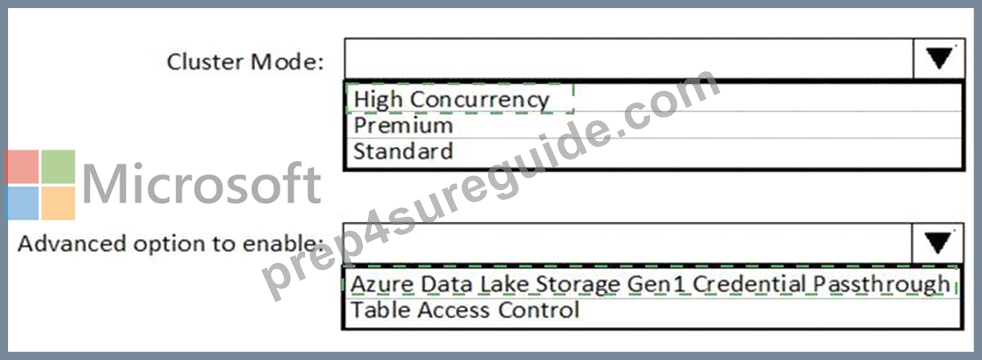
Explanation
Box 1: High Concurrency
Enable Azure Data Lake Storage credential passthrough for a high-concurrency cluster.
Incorrect:
Support for Azure Data Lake Storage credential passthrough on standard clusters is in Public Preview.
Standard clusters with credential passthrough are supported on Databricks Runtime 5.5 and above and are limited to a single user.
Box 2: Azure Data Lake Storage Gen1 Credential Passthrough
You can authenticate automatically to Azure Data Lake Storage Gen1 and Azure Data Lake Storage Gen2 from Azure Databricks clusters using the same Azure Active Directory (Azure AD) identity that you use to log into Azure Databricks. When you enable your cluster for Azure Data Lake Storage credential passthrough, commands that you run on that cluster can read and write data in Azure Data Lake Storage without requiring you to configure service principal credentials for access to storage.
References:
https://docs.azuredatabricks.net/spark/latest/data-sources/azure/adls-passthrough.html
NEW QUESTION # 191
You are designing an Azure Synapse Analytics dedicated SQL pool.
Groups will have access to sensitive data in the pool as shown in the following table.
You have policies for the sensitive dat
a. The policies vary be region as shown in the following table.
You have a table of patients for each region. The tables contain the following potentially sensitive columns.
You are designing dynamic data masking to maintain compliance.
For each of the following statements, select Yes if the statement is true. Otherwise, select No.
NOTE: Each correct selection is worth one point.
Answer:
Explanation:
Reference:
https://docs.microsoft.com/en-us/azure/azure-sql/database/dynamic-data-masking-overview
NEW QUESTION # 192
You have an Azure Synapse Analytics workspace named WS1.
You have an Azure Data Lake Storage Gen2 container that contains JSON-formatted files in the following format.
You need to use the serverless SQL pool in WS1 to read the files.
How should you complete the Transact-SQL statement? To answer, drag the appropriate values to the correct targets. Each value may be used once, more than once, or not at all. You may need to drag the split bar between panes or scroll to view content.
NOTE: Each correct selection is worth one point.
Answer:
Explanation:
Explanation
Graphical user interface, text, application, email Description automatically generated
Box 1: openrowset
The easiest way to see to the content of your CSV file is to provide file URL to OPENROWSET function, specify csv FORMAT.
Example:
SELECT *
FROM OPENROWSET(
BULK 'csv/population/population.csv',
DATA_SOURCE = 'SqlOnDemandDemo',
FORMAT = 'CSV', PARSER_VERSION = '2.0',
FIELDTERMINATOR =',',
ROWTERMINATOR = '\n'
Box 2: openjson
You can access your JSON files from the Azure File Storage share by using the mapped drive, as shown in the following example:
SELECT book.* FROM
OPENROWSET(BULK N't:\books\books.json', SINGLE_CLOB) AS json
CROSS APPLY OPENJSON(BulkColumn)
WITH( id nvarchar(100), name nvarchar(100), price float,
pages_i int, author nvarchar(100)) AS book
Reference:
https://docs.microsoft.com/en-us/azure/synapse-analytics/sql/query-single-csv-file
https://docs.microsoft.com/en-us/sql/relational-databases/json/import-json-documents-into-sql-server
NEW QUESTION # 193
You are designing an enterprise data warehouse in Azure Synapse Analytics that will store website traffic analytics in a star schema.
You plan to have a fact table for website visits. The table will be approximately 5 GB.
You need to recommend which distribution type and index type to use for the table. The solution must provide the fastest query performance.
What should you recommend? To answer, select the appropriate options in the answer area.
NOTE: Each correct selection is worth one point.
Answer:
Explanation: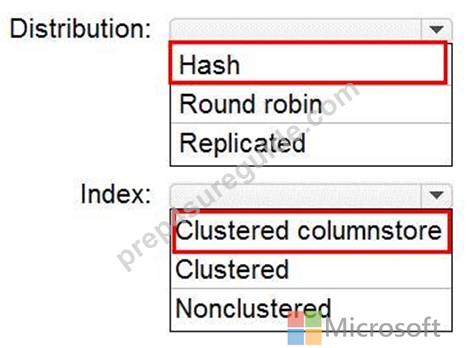
Reference:
https://docs.microsoft.com/en-us/azure/synapse-analytics/sql-data-warehouse/sql-data-warehouse-tables-distribute
https://docs.microsoft.com/en-us/azure/synapse-analytics/sql-data-warehouse/sql-data-warehouse-tables-index
NEW QUESTION # 194
You build an Azure Data Factory pipeline to move data from an Azure Data Lake Storage Gen2 container to a database in an Azure Synapse Analytics dedicated SQL pool.
Data in the container is stored in the following folder structure.
/in/{YYYY}/{MM}/{DD}/{HH}/{mm}
The earliest folder is /in/2021/01/01/00/00. The latest folder is /in/2021/01/15/01/45.
You need to configure a pipeline trigger to meet the following requirements:
Existing data must be loaded.
Data must be loaded every 30 minutes.
Late-arriving data of up to two minutes must he included in the load for the time at which the data should have arrived.
How should you configure the pipeline trigger? To answer, select the appropriate options in the answer area.
NOTE: Each correct selection is worth one point.
Answer:
Explanation:
Reference:
https://docs.microsoft.com/en-us/azure/data-factory/how-to-create-tumbling-window-trigger
NEW QUESTION # 195
You have an Azure Data Lake Storage Gen2 account named adls2 that is protected by a virtual network.
You are designing a SQL pool in Azure Synapse that will use adls2 as a source.
What should you use to authenticate to adls2?
- A. a managed identity
- B. a shared access signature (SAS)
- C. a shared key
- D. an Azure Active Directory (Azure AD) user
Answer: A
Explanation:
Managed identity for Azure resources is a feature of Azure Active Directory. The feature provides Azure services with an automatically managed identity in Azure AD. You can use the Managed Identity capability to authenticate to any service that support Azure AD authentication.
Managed Identity authentication is required when your storage account is attached to a VNet.
Reference:
https://docs.microsoft.com/en-us/azure/synapse-analytics/sql-data-warehouse/quickstart-bulk-load-copy-tsql-examples
NEW QUESTION # 196
You plan to create an Azure Data Lake Storage Gen2 account
You need to recommend a storage solution that meets the following requirements:
* Provides the highest degree of data resiliency
* Ensures that content remains available for writes if a primary data center fails What should you include in the recommendation? To answer, select the appropriate options in the answer area.
Answer:
Explanation:
NEW QUESTION # 197
You need to implement an Azure Databricks cluster that automatically connects to Azure Data Lake Storage Gen2 by using Azure Active Directory (Azure AD) integration.
How should you configure the new cluster? To answer, select the appropriate options in the answer area.
NOTE: Each correct selection is worth one point.
Answer:
Explanation:
Reference:
https://docs.azuredatabricks.net/spark/latest/data-sources/azure/adls-passthrough.html
NEW QUESTION # 198
You have an Azure Data Factory pipeline that has the activity shown in the following exhibit.
Use the drop-down menus to select the answer choice that completes each statement based on the information presented in the graphic.
Answer:
Explanation:
Explanation
NEW QUESTION # 199
You have an Azure Synapse Analytics serverless SQL pool, an Azure Synapse Analytics dedicated SQL pool, an Apache Spark pool, and an Azure Data Lake Storage Gen2 account.
You need to create a table in a lake database. The table must be available to both the serverless SQL pool and the Spark pool.
Where should you create the table, and Which file format should you use for data in the table? TO answer, select the appropriate options in the answer are a.
NOTE: Each correct selection is worth one point.
Answer:
Explanation:
NEW QUESTION # 200
You have an Azure Synapse Analytics dedicated SQL pool.
You need to monitor the database for long-running queries and identify which queries are waiting on resources Which dynamic management view should you use for each requirement? To answer, select the appropriate options in the answer area.
NOTE; Each correct answer is worth one point.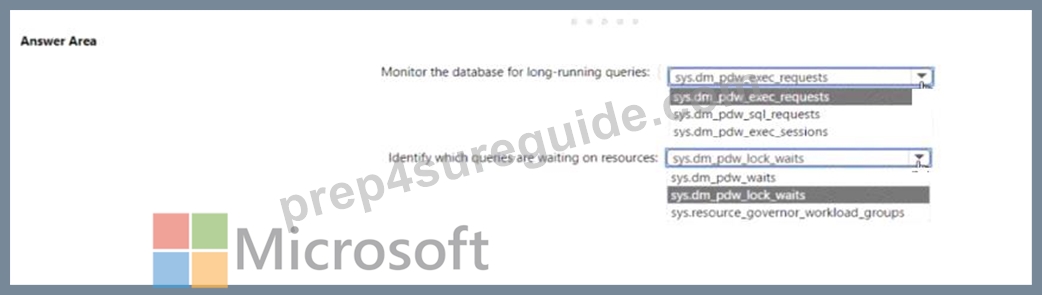
Answer:
Explanation:
Explanation
NEW QUESTION # 201
You have a self-hosted integration runtime in Azure Data Factory.
The current status of the integration runtime has the following configurations:
* Status: Running
* Type: Self-Hosted
* Version: 4.4.7292.1
* Running / Registered Node(s): 1/1
* High Availability Enabled: False
* Linked Count: 0
* Queue Length: 0
* Average Queue Duration. 0.00s
The integration runtime has the following node details:
* Name: X-M
* Status: Running
* Version: 4.4.7292.1
* Available Memory: 7697MB
* CPU Utilization: 6%
* Network (In/Out): 1.21KBps/0.83KBps
* Concurrent Jobs (Running/Limit): 2/14
* Role: Dispatcher/Worker
* Credential Status: In Sync
Use the drop-down menus to select the answer choice that completes each statement based on the information presented.
NOTE: Each correct selection is worth one point.
Answer:
Explanation:
Explanation
Box 1: fail until the node comes back online
We see: High Availability Enabled: False
Note: Higher availability of the self-hosted integration runtime so that it's no longer the single point of failure in your big data solution or cloud data integration with Data Factory.
Box 2: lowered
We see:
Concurrent Jobs (Running/Limit): 2/14
CPU Utilization: 6%
Note: When the processor and available RAM aren't well utilized, but the execution of concurrent jobs reaches a node's limits, scale up by increasing the number of concurrent jobs that a node can run Reference:
https://docs.microsoft.com/en-us/azure/data-factory/create-self-hosted-integration-runtime
NEW QUESTION # 202
You have an Azure subscription.
You plan to build a data warehouse in an Azure Synapse Analytics dedicated SQL pool named pool1 that will contain staging tables and a dimensional model. Pool1 will contain the following tables.
You need to design the table storage for pool1. The solution must meet the following requirements:
Maximize the performance of data loading operations to Staging.WebSessions.
Minimize query times for reporting queries against the dimensional model.
Which type of table distribution should you use for each table? To answer, drag the appropriate table distribution types to the correct tables. Each table distribution type may be used once, more than once, or not at all. You may need to drag the split bar between panes or scroll to view content.
NOTE: Each correct selection is worth one point.
Answer:
Explanation: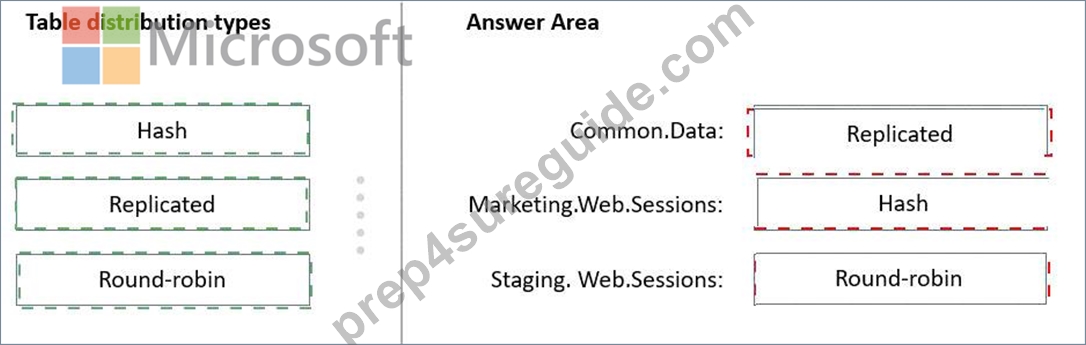
Explanation
Box 1: Replicated
The best table storage option for a small table is to replicate it across all the Compute nodes.
Box 2: Hash
Hash-distribution improves query performance on large fact tables.
Box 3: Round-robin
Round-robin distribution is useful for improving loading speed.
Reference:
https://docs.microsoft.com/en-us/azure/synapse-analytics/sql-data-warehouse/sql-data-warehouse-tables-distribu
NEW QUESTION # 203
......
Most Reliable Microsoft DP-203 Training Materials: https://www.prep4sureguide.com/DP-203-prep4sure-exam-guide.html
The Realest Study Materials DP-203 Dumps: https://drive.google.com/open?id=1OCHBi7BdU59KS2RRbofZGh-kHTyIRY7S