


Grab latest Huawei H12-821_V1.0 Dumps as PDF Updated on 2026
Newly Released H12-821_V1.0 Dumps for HCIP-Datacom Certified
NEW QUESTION # 72
Which of the following statements regarding the MED value in BGP are true?
- A. By default, BGP can compare the MED values of routes from different ASs.
- B. The default MED value of BGP routes is 0.
- C. By default, if there is no MED value in routes, the value 0 is used. If the bestroute med-none-as- maximum command is configured, the maximum MED value 4294967295 is used.
- D. According to BGP route selection rules, the MED value has a lower priority than AS_Path, Preferred- Value, Local-Preference, and Origin.
Answer: C,D
Explanation:
The MED (Multi-Exit Discriminator) is an optional, non-transitive attribute used to influence the exit path.
MED is considered after attributes such as Local-Preference, AS-Path, and Origin during route selection. By default, if a MED value is missing, it is treated as 0 unless the bestroute med-none-as-maximum command is configured to treat it as 4294967295 .
NEW QUESTION # 73
OSPF has five types of packets, which have the same header format. If the Auth Type field in the packet header is 1, which of the following authentication modes is used?
- A. Hash authentication
- B. Non-authentication
- C. Plaintext authentication
- D. MD5 authentication
Answer: C
Explanation:
The Auth Type field in the OSPF packet header determines the authentication mode. If the Auth Type is 1, plaintext authentication is used.
Plaintext authentication involves transmitting the password in an easily readable format, which is less secure compared to MD5.
NEW QUESTION # 74
Which of the following statement regarding the display ospf peer command output is true?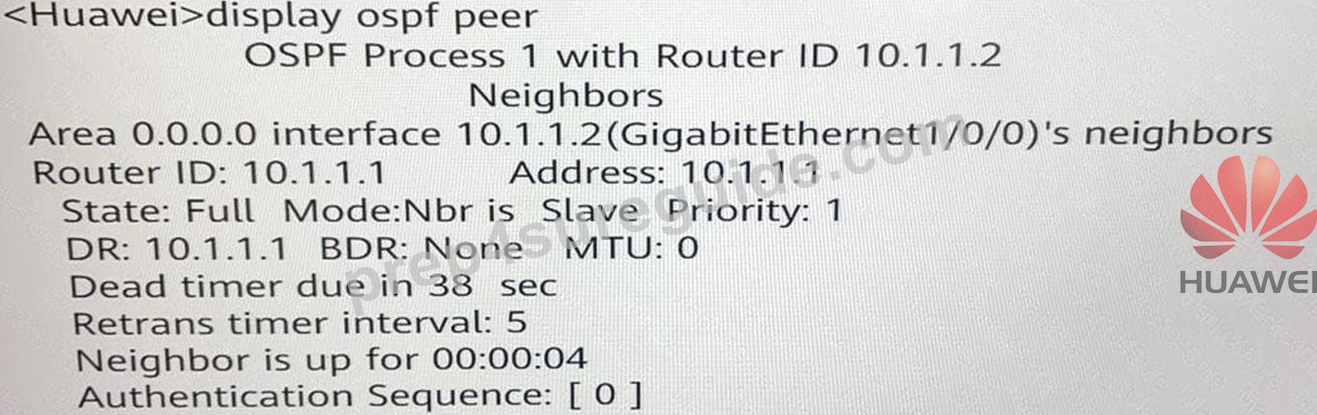
- A. The DR address is 10.1.1.1
- B. Through negotiation during DD packet exchange, the local end becomes the slave.
- C. Address: 10.1,1.1 Indicates that the local interface address is 10.1.1.1.
- D. Router ID indicates that the local router ID Is 10.1.1.1.
Answer: B
Explanation:
The command output indicates that the OSPF neighbor state is Full and that the neighbor relationship has been established. The statement confirms that the negotiation process during the exchange of DD (Database Description) packets has determined the role of the router, with the local device becoming the slave in the Master-Slave relationship, which is critical for LSA synchronization. The other options do not align with the output or OSPF principles
NEW QUESTION # 75
Which of the following descriptions about configuring the set-overload command in IS-IS is correct?
- A. This command is used to enable IS-IS to automatically calculate the interface cost according to the bandwidth
- B. This command allows the device to set the time for the system to maintain the overload flag according to the state of BGP convergence
- C. This command is used to specify that the Hello message sent after the device restarts carries the SA bit
- D. This command is used to set the overload flag bit of non-pseudo-node LSP
Answer: D
NEW QUESTION # 76
Which statement about RIB and FIB is wrong?
- A. The next-hop in RIB is the IP address of the peer directly connected to the neighbor interface
- B. FIB is generated by RIB
- C. FIB directs the forwarding of packets
- D. RIB does not directly guide the forwarding of packets
Answer: A
NEW QUESTION # 77
The OSPF protocol has authentication capabilities for all data packets exchanged between neighboring routers.
In the VRP system, which of the following algorithms does OSPF support?
- A. RSA
- B. DES
- C. MD5
- D. AES
Answer: C
NEW QUESTION # 78
In a broadcast network, IS-IS establishes neighbor relationships through () handshakes.
Answer:
Explanation:
3
NEW QUESTION # 79
An enterprise uses Huawei routers to deploy an IS-IS network for network-wide communication. An engineer wants to change the interface cost to control route selection. By default, which of the following values is the maximum cost that can be configured?
- A. 0
- B. 1
- C. 2
- D. 3
Answer: A
Explanation:
Comprehensive and Detailed in-depth Step-by-Step Explanation:In IS-IS, the interface cost is a metric used to determine the best path to a destination. Lower-cost paths are preferred over higher-cost paths. By default, IS-IS interface costs can range from 1 to 63.
* Default Cost Range:
* IS-IS allows the configuration of interface costs within the range of 1-63 by default. This range is sufficient for most networks.
* Maximum Configurable Cost:
* The maximum value that can be configured by default is 63. If there is a requirement for a higher cost range, the metric-style can be changed to wide, which allows the cost range to extend beyond 63.
* Option A (67): Incorrect. 67 is not the maximum default value.
* Option B (63): Correct. This is the maximum default cost value.
* Option C (64): Incorrect. This is beyond the default range.
* Option D (68): Incorrect. This is beyond the default range.
References:
* Huawei HCIA-Datacom Study Guide, Chapter on "IS-IS Cost and Route Selection".
* RFC 5308 - Routing IPv6 with IS-IS.
NEW QUESTION # 80
Which of the following statements regarding multicast MAC addresses are false?
- A. One multicast MAC address maps to 32 multicast IP addresses.
- B. A multicast MAC address identifies receivers of a multicast group on the data link layer.
- C. The high 24 bits of the multicast MAC address are 0x01005E, the 25th bit is fixed to 1, and the lower 23 bits of the MAC address map to the lower 23 bits of the multicast IP address.
- D. One multicast MAC address maps to only one multicast IP address.
Answer: D
Explanation:
One multicast MAC address maps to 32 multicast IP addresses due to the limited number of bits used in the mapping process. Specifically, the lower 23 bits of the MAC address map to the lower 23 bits of the multicast IP address, while the high 24 bits of the MAC address are fixed as 0x01005E.
NEW QUESTION # 81
RSTP provides different functions in different scenarios. Which of the following statements Is false?
- A. When the designated port enabled with root protection receives optimal RST BPDUs, the port enters the Discarding state and does not forward packets. If the port does not receive optimal RST BPDUs within a certain period of time, the port will automatically restore to the Forwarding state
- B. If the edge port on the switch enabled with BPDU protection receives RST BPDU, the switch sets the edge port as a non-edge-port and triggers STP calculation
- C. The role of the designated port that is enabled with root protection cannot be changed
- D. After TC-BPDU attack defense function is enabled, you can set the number of times the switch processes TC BPDUs within a certain period
Answer: C
Explanation:
Root protection ensures that a designated port does not become a root port by discarding superior BPDUs.
However, if superior BPDUs are no longer received, the port can return to its original forwarding state, meaning its role can change. This makes option B incorrect, while the other options correctly describe RSTP behavior .
NEW QUESTION # 82
What is the default sending interval of BFD packets?
- A. 5s
- B. 10s
- C. 1000ms
- D. 100ms
Answer: D
Explanation:
The default sending interval for BFD (Bidirectional Forwarding Detection) control packets is 100 milliseconds. This interval ensures rapid detection of link faults, providing fast failover and minimizing downtime in network operations .
NEW QUESTION # 83
The linkage between BFD and OSPF uses BFD's rapid sensing of link failures to speed up the OSPF protocol's response to network topology changes, which can increase the OSPF convergence speed from seconds to milliseconds.
- A. FALSE
- B. TRUE
Answer: B
NEW QUESTION # 84
OSPF networks are classified into broadcast, P2P, P2MP, and NBMA networks. Which of the following types of networks use the default Hello time (30s)?
- A. P2MP
- B. NBMA
- C. Broadcast
- D. P2P
Answer: A,B
Explanation:
Comprehensive and Detailed Step-by-Step Explanation:
* Default OSPF Hello Timer:
* The OSPF Hello timer is used to send periodic Hello packets and maintain neighbor relationships.
* Default Hello timers:
* Broadcast and P2P: 10 seconds
* NBMA and P2MP: 30 seconds
* Network Types Using 30s Hello Time:
* P2MP (C): OSPF sends Hello packets every 30 seconds by default.
* NBMA (D): OSPF also uses 30 seconds for NBMA networks.
References:
* HCIA-Datacom Study Guide, Chapter: OSPF Network Types
* Huawei OSPF Timer Configuration
NEW QUESTION # 85
Which of the following is a VPN technology that neither supports user identity authentication nor data encryption and verification?
- A. L2TP Over IPSec
- B. SSLVPN
- C. MPLS VPN
- D. GRE Over IPSec
- E. L2TP VPN
- F. GREVPN
Answer: C
NEW QUESTION # 86
As shown in the following figure, a new AP is deployed In dual link MSB networking (load balancing mode).
Which AC will the connect to?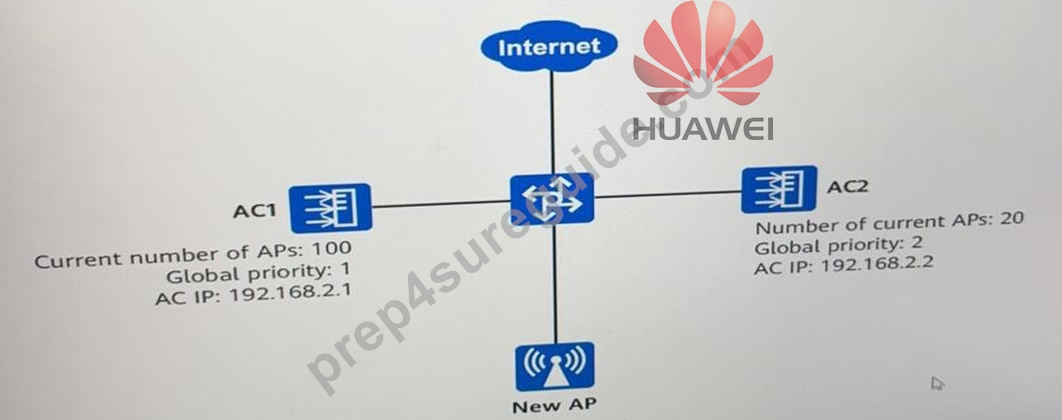
- A. AC2
- B. Random access
- C. AC1
- D. None
Answer: D
NEW QUESTION # 87
On the OSPF network shown in the figure, an adjacency has been established between R1 and R2. An engineer configures the commands in the figure on R2.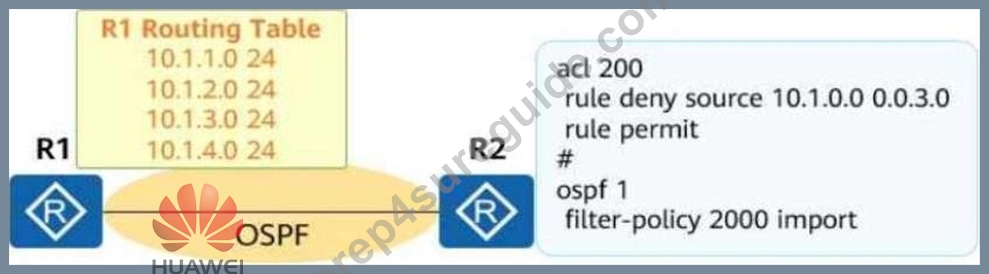
In this case, which of the following routing entries may exist in the routing table of R2?
- A. 10.1.1.0/24
- B. 10.1.3.0/24
- C. 10.1.4.0/24
- D. 10.1.2.0/24
Answer: B,C,D
NEW QUESTION # 88
Which of the following descriptions about the default sending time interval of BFD detection packets is correct?
- A. The default sending interval is 10 milliseconds
- B. The default sending interval is 1000 milliseconds
- C. The default sending interval is 5 milliseconds
- D. The default sending interval is 100 milliseconds
Answer: B
NEW QUESTION # 89
Which of the following descriptions about the ACL matching mechanism are correct? (Multiple choice)
- A. When the matching order of the ACL is the config mode, it will be matched in descending order of the serial number
- B. If the ACL exists but there is no rule inside the ACL, the result will be directly returned as "does not match"
- C. After the packet matches the ACL, only two results will be generated: "match" and "mismatch"
- D. When the packet matches the ACL, if the packet hits the rule and the ACL action is "permit", the matching result is "match". When the packet hits the rule and the ACL action is "deny", it returns The result is "does not match"
Answer: B,C
NEW QUESTION # 90
The following is a partial configuration of a router.
The correct description of this configuration is: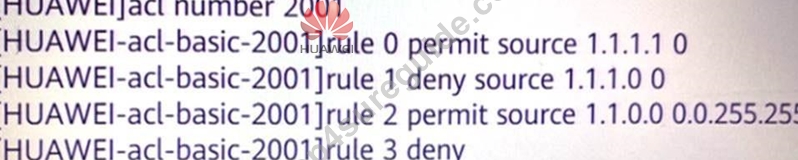
- A. The data packet whose source address is 1.1.1.1 matches the first ACL statement rule 0, and the matching rule is Allow.
- B. The data packet whose source address is 1.1.1.4 matches the fourth ACL statement rule 3, and the matching rule is Allow.
- C. The data packet whose source address is 1.1.1.3 matches the third ACL statement rule 2, and the matching rule is Deny.
- D. The data packet whose source address is 1.1.1.2 matches the second ACL statement rule 1, and the matching rule is Allow.
Answer: A
NEW QUESTION # 91
As shown in the figure, data traffic is forwarded in tunnel mode along the path of STA -> HAP -> HAC -> upper-layer network before roaming. What is the flow direction of data traffic after Layer 3 roaming?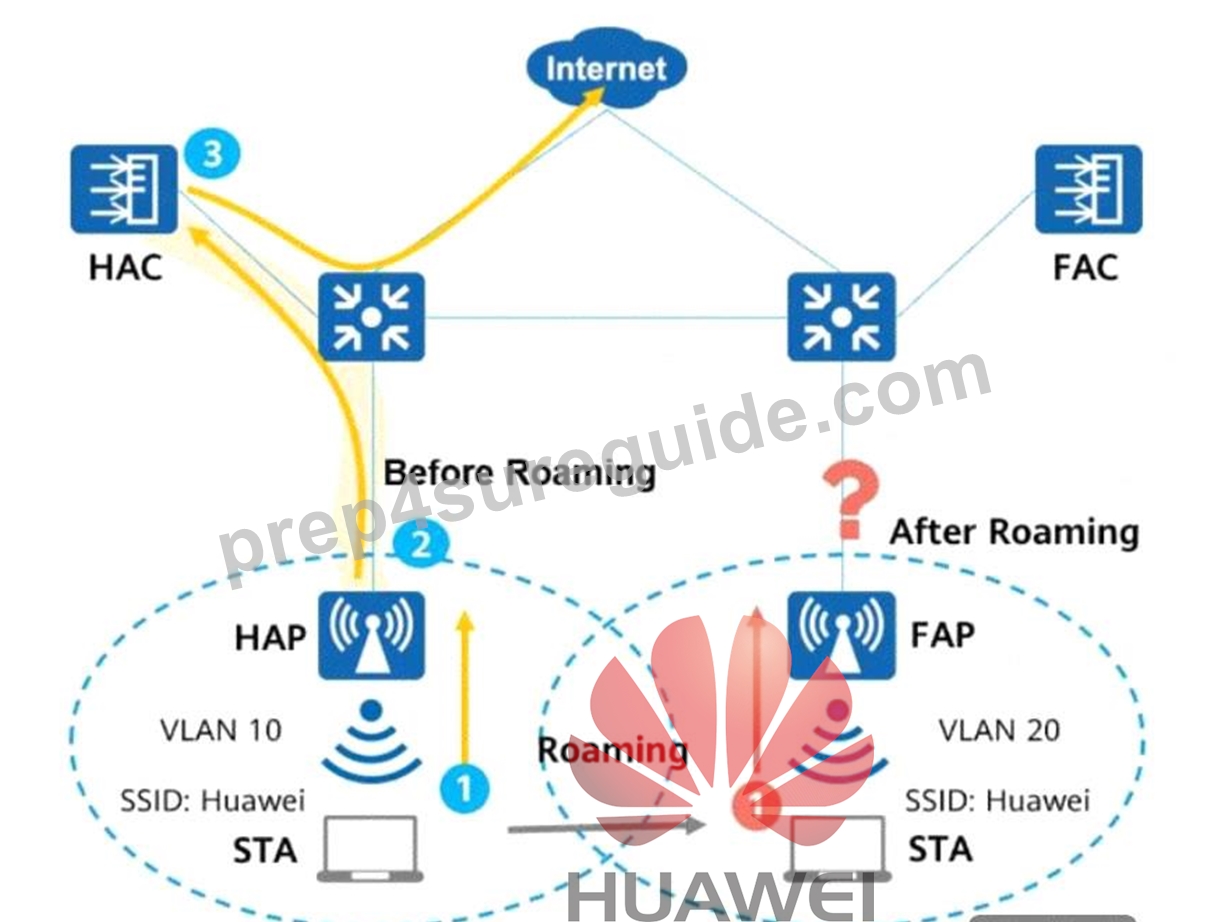
- A. STA -> FAP -> FAC -> HAC -> HAP -> HAC -> Upper-layer network
- B. STA -> FAP -> FAC -> HAC -> Upper-layer network
- C. STA -> FAP -> FAC -> Upper-layer network
- D. STA -> FAP -> FAC -> HAC -> HAP -> Upper-layer network
Answer: B
Explanation:
After Layer 3 roaming, the STA's traffic is forwarded from the Foreign AP (FAP) to the Foreign AC (FAC), and then to the Home AC (HAC) before reaching the upper-layer network. This ensures that the STA remains on the same subnet without breaking existing sessions .
NEW QUESTION # 92
......
Huawei H12-821_V1.0 (HCIP-Datacom-Core Technology V1.0) exam is a valuable certification for IT professionals who want to demonstrate their expertise in core data communication technologies. Passing H12-821_V1.0 exam validates the candidate's knowledge and skills in the latest networking technologies and provides them with a competitive advantage in the job market.
Latest H12-821_V1.0 Exam Dumps Huawei Exam from Training: https://www.prep4sureguide.com/H12-821_V1.0-prep4sure-exam-guide.html
Updated Verified H12-821_V1.0 dumps Q&As - 100% Pass: https://drive.google.com/open?id=1is3LtmgC9jyeT-6-DRIyp6HYqAWFZIRm