


Get PPAN01 Products Practice Material for PPAN01 Exam Question Preparation
Most Reliable Proofpoint PPAN01 Training Materials
NEW QUESTION # 11
Which two threat protection capabilities are available as part of Proofpoint's Targeted Attack Protection (TAP)? (Select two.)
- A. Pulls malicious emails from user inbox after delivery
- B. Training solution that drives user behavioral change
- C. Cloud-based solution that remediates threats post-delivery
- D. Provides protection against URL-based email threats
- E. Protects users against threats in email attachments
Answer: D,E
Explanation:
TAP is Proofpoint's detection and analysis layer for advanced email threats, with core capabilities focused on URL-based threats and attachment-based threats. URL Defense (C) rewrites links and performs time-of-click analysis to block newly malicious destinations and provide click telemetry for investigations. Attachment Defense (E) analyzes file payloads (including sandbox/detonation and static reputation approaches depending on configuration) to detect malware and suspicious content that may evade traditional gateway signatures.
These two capabilities are central to TAP's role in detection and analysis: they generate verdicts, campaign clustering, and exposure metrics (Intended/At Risk/Impacted) used by SOC teams to prioritize response. Post- delivery remediation ("pull from inbox" or "remediate post-delivery") is not TAP's primary function; that is typically handled by TRAP/Cloud Threat Response capabilities (A/D). User training is handled by Proofpoint Security Awareness/ZenGuide solutions (B), which complement TAP by reducing click rates and improving reporting, but are not TAP threat protection capabilities. TAP's value in IR is turning email threat content (URLs/attachments) into actionable, scoped, measurable incidents.
NEW QUESTION # 12
An attacker registers a domain like "great-company.com" to impersonate "greatcompany.com." What tactic is being used?
- A. Domain Hijacking
- B. Lookalike Domain
- C. Display Name Spoofing
- D. Subdomain Takeover
Answer: B
NEW QUESTION # 13
Refer to the exhibit.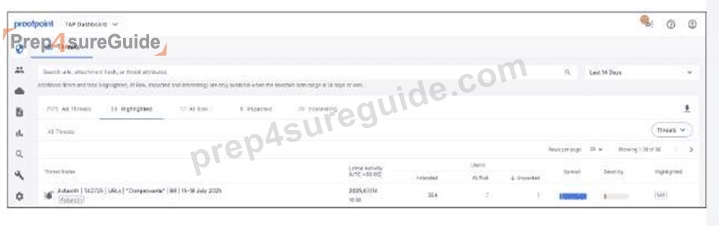
Which two determinations can be made by the data shown on the TAP Dashboard in the exhibit? (Select two.)
- A. 354 users are at risk from this phishing campaign.
- B. The threat has been seen by all Proofpoint customers.
- C. One user clicked on a rewritten URL.
- D. The impacted user was definitely a VIP.
- E. Seven users received this threat message.
Answer: C,E
Explanation:
TAP dashboard widgets and threat cards commonly provide the "funnel" metrics and interaction telemetry needed for rapid scoping. From the exhibit, you can directly determine that seven users received the threat message (C) and that one user clicked on a rewritten URL (E). These are concrete, environment-specific facts derived from recipient exposure and click tracking through URL Defense rewriting. Claims like "seen by all Proofpoint customers" (A) are global intelligence statements and are not typically provable from a single customer's threat card unless explicitly shown. VIP status (B) cannot be asserted as "definitely" unless the UI explicitly flags VIP for that impacted user. "354 users at risk" (D) may be a different metric in some views, but the question's exhibit-driven determinations are the ones unambiguously shown: recipients count and rewritten click count. In Proofpoint IR triage, these two determinations immediately guide response: (1) scope the recipient list for remediation (TRAP pull, user notifications), and (2) prioritize the clicker for compromise checks (credential reset, token revocation, mailbox rule audit), because clicks convert exposure into potential incident impact.
NEW QUESTION # 14
An analyst is reviewing the Threats page in the TAP Dashboard.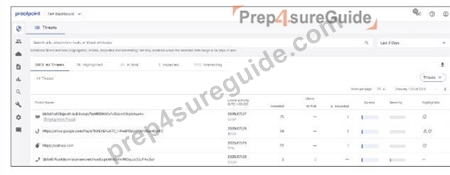
Which of the top four threats seen in the exhibit should be prioritised for investigation?
- A. The Malware Delivery threat
- B. The TOAD (Telephone-Oriented Attack Delivery) threat
- C. The BEC (Business Email Compromise) threat
- D. The Credential Phishing threat
Answer: D
Explanation:
In Proofpoint-driven triage, threats are prioritized by likelihood of immediate compromise and blast radius.
Credential phishing typically ranks highest because a single successful credential submission can lead to account takeover (ATO), which then enables follow-on attacks: internal phishing, mailbox rule abuse, OAuth consent abuse, wire-fraud/BEC escalation, and data access. Proofpoint TAP surfaces credential phishing with strong indicators (URL defense verdicts, rewritten URL clicks, campaign clustering, and known phishing kits
/landing pages), making it actionable for containment. Compared to malware delivery, credential theft often bypasses endpoint controls and produces fewer immediate artifacts, so rapid response is critical: password reset, token revocation, MFA enforcement, and mailbox audit. TOAD and BEC can be high impact, but in many environments they require human interaction outside email controls (phone/social steps) and may not always show definitive technical IOCs early. The TAP "Threats" view is designed for quick pivoting (Intended/At Risk/Impacted) and credential phishing typically correlates strongly with "Impacted" activity (clicks/submissions), which is why it should be investigated first when competing items are present.
NEW QUESTION # 15
What action does Proofpoint Collab Protection take when a malicious URL is detected?
- A. Redirects the browser to a block page.
- B. Sends an alert to the user's manager.
- C. Encrypts the browser session.
- D. Automatically deletes the URL from the system.
Answer: A
Explanation:
Proofpoint Collab Protection extends threat controls into collaboration channels (e.g., links shared in chat
/collaboration platforms). When a malicious URL is detected, the immediate containment objective is to prevent a user from reaching the destination. The standard enforcement action is to redirect the user to a block page (D), analogous to URL Defense time-of-click blocking in email. This prevents credential harvesting and drive-by compromise while providing clear user feedback that the link was identified as unsafe. From an IR containment perspective, a block-page redirect also creates consistent telemetry: analysts can correlate attempted access events, identify which users attempted to follow the link, and scope the spread of the malicious content across channels (who posted it, who received it, who clicked). Unlike "deleting the URL from the system," which is not realistic in distributed collaboration content, the block-page model is an enforceable control that works at access time. In recovery, responders still validate whether any users accessed the URL outside protected paths and then apply additional mitigations (IOC blocking, user notification, and account checks if the link was credential-phishing).
NEW QUESTION # 16
Heuristic analysis, signature-based detection, and reputation-based methods are all examples of which type of cybersecurity analysis technique?
- A. Static Analysis
- B. Behavioral Analysis
- C. Log Analysis
- D. Traffic Analysis
Answer: A
Explanation:
Heuristic, signature, and reputation-based methods are classic static analysis approaches (D) because they evaluate artifacts and indicators without requiring full execution observation of the payload's runtime behavior. In Proofpoint email security, these methods appear across attachment and URL analysis pipelines:
signature-based matching for known malware patterns, heuristic rules for suspicious structures (macro patterns, obfuscation traits, spoofing characteristics), and reputation scoring for URLs/domains/IPs based on historical maliciousness and observed telemetry. This differs from behavioral/dynamic analysis, which relies on execution in a sandbox environment to observe actions (process injection, network callbacks, file writes).
In day-to-day IR triage, static techniques are often the first layer of detection because they are fast and scalable, enabling immediate condemnation and quarantine decisions at the gateway. Analysts then use TAP dashboards to corroborate static verdicts with additional context (campaign patterns, click behavior, impacted users) and decide containment actions (TRAP pulls, blocklists, user remediation). Understanding that these are static techniques helps responders interpret verdict confidence and know when additional dynamic evidence is needed.
NEW QUESTION # 17
What is a defining characteristic of Advanced Persistent Threat (APT) actors?
- A. They are state-sponsored and target strategic assets.
- B. They focus on short-term financial scams.
- C. They primarily use social engineering to gain access.
- D. They operate independently without government affiliation.
Answer: A
Explanation:
APT actors are characterized by strategic intent, persistence, and resourcing-commonly associated with state sponsorship or alignment-targeting sensitive assets such as government, defense, critical infrastructure, research IP, and executive communications. In Proofpoint-centered investigations, APT-style campaigns often show tailored lures (highly contextual pretexting), careful targeting (VIPs, finance, legal, IT), and "low-and- slow" operational patterns that reduce obvious malware signals. They may use credential phishing, session hijacking, or BEC-style social engineering as initial access, then pivot to living-off-the-land techniques and stealthy persistence in cloud mailboxes (inbox rules, forwarding, OAuth grants). Proofpoint telemetry (campaign clustering, threat actor mapping where available, impersonation indicators, supplier compromise signals) supports detection and scoping, but the defining attribute remains the attacker's strategic targeting and persistence rather than any single technique. This distinction matters operationally: APT suspicion raises escalation thresholds, broadens scoping (adjacent mailboxes, suppliers, cloud audit logs), increases evidence preservation rigor, and typically triggers executive/legal coordination earlier in the response lifecycle.
NEW QUESTION # 18
What happens when a user clicks a rewritten URL that TAP URL Defense has determined to be malicious?
- A. The user is shown a warning page and the site is blocked.
- B. The link opens normally and the site remains accessible.
- C. The system delivers a separate email alert to the user.
- D. The user is redirected to the organization's homepage.
Answer: A
Explanation:
Proofpoint TAP URL Defense rewrites URLs to route clicks through Proofpoint's time-of-click analysis service. If the destination is determined malicious at click time, the user is presented with a block/warning page and access is denied (A). This is a core containment mechanism because URL reputation can change after delivery: a link that looked benign during initial scanning may become weaponized later (compromised site, delayed redirect, newly hosted phishing kit). The warning page both prevents compromise and provides user feedback that a threat was intercepted. For IR responders, this behavior is also valuable telemetry: TAP records click events, verdicts, and whether clicks were blocked or permitted, which drives scoping and prioritization (Impacted users vs At Risk). In recovery, blocked clicks reduce the likelihood that credential resets or endpoint remediation are needed, but analysts still validate whether any earlier clicks occurred before condemnation, whether users accessed the URL outside protected paths (copy/paste, mobile clients), and whether campaign-wide remediation (blocklisting domains, pulling emails) is necessary to prevent repeat attempts.
NEW QUESTION # 19
What best describes the nature of the NIST incident response lifecycle?
- A. A cyclical process focused on continuous improvement.
- B. A reactive-only approach to cyber threats.
- C. A one-time checklist for handling incidents.
- D. A linear process from detection to recovery.
Answer: A
Explanation:
NIST SP 800-61 defines incident response as an iterative lifecycle-Preparation # Detection & Analysis # Containment/Eradication/Recovery # Post-Incident Activity-where outputs from each incident are fed back into strengthening controls and readiness. In Proofpoint-focused IR, this cyclical nature is especially visible because email/social engineering threats evolve continuously and defenders must tune controls over time. For example, a credential phishing incident may drive updates to TAP/TRAP workflows (auto-pull policies, detection rules), user coaching (ZenGuide "Report Suspicious" adoption), and hardening changes (DMARC enforcement, MFA policy, OAuth app governance). Post-incident metrics (time-to-detect, time-to-quarantine, click rate, submission-to-verdict time) become inputs for improving alerting, triage filters, and escalation criteria. Proofpoint platforms also support retroactive actions (e.g., post-delivery quarantine), which encourages a "detect, respond, learn, and reduce recurrence" loop. Treating IR as linear or one-time fails in practice because threat actors retool rapidly, and organizations must continuously refine technical controls, playbooks, and human processes to maintain resilience.
NEW QUESTION # 20
An analyst has been tasked with providing a report that can be used to prioritise investigations based on a user's Attack Index score. Which report would be most suitable for this purpose?
- A. Very Attacked People
- B. Top 10 Clickers
- C. VIP Activity
- D. Top 10 Recipients
Answer: A
Explanation:
Attack Index is a user-level risk/burden metric intended to help SOC teams prioritize which people to investigate first based on the amount and severity/diversity of threat activity directed at them (and often their exposure/interaction, depending on module). The report that directly supports that workflow is "Very Attacked People," which is designed to surface users with the highest Attack Index and concentration of targeted threats. Operationally, this aligns with IR queue management: instead of treating all alerts equally, analysts use user-centric risk ranking to focus on likely compromise candidates (e.g., frequent recipients of credential phishing, repeated exposure to the same campaign, or elevated threat severity). "Top 10 Recipients" is volume-oriented and may include benign bulk mail; "Top 10 Clickers" is behavior-oriented but does not necessarily reflect overall threat burden; and "VIP Activity" is scoped to a subset (VIPs) rather than the complete organization's risk ranking. In Proofpoint-led IR best practice, this report is commonly used to drive daily standups, assign investigations, and justify proactive account checks (MFA posture, suspicious logins, mailbox rules) for the highest-risk users.
NEW QUESTION # 21
Refer to Exhibit:
X-Proofpoint-Banner-Trigger: inbound
MIM-version: 1.0
Content-Type: multipart/mixed; boundary="boundary-1698346305"
X-CLX-Shades: MLX
X-Proofpoint-Virus-Version: vendor=baseguard
engine=ICAP:2.0.272,Aquarius:18.0.987,Hydra:6.0.619,FMLib:17.11.176.26 definitions=2023-10-26_22,
2023-10-26_01,2023-05-22_02
X-Proofpoint-Spam-Details: rule=spam policy=default score=89 bulkscore=0 phishscore=0 mlxlogscore=-91 suspectscore=0 malwarescore=0 adultscore=0 spamscore=89 classifier=spam adjust=0 reason=mlx scancount=l engine=8.12.0-2310240000 definitions=main-2310260209 In the process of reviewing a false positive, you see the following email header. What was the reason the message was quarantined by the Proofpoint Protection Server?
- A. The recipient's personal block list forced quarantine of the message.
- B. A custom spam rule caused the message to be quarantined.
- C. A content policy rule (DLP/compliance) forced quarantine of the message.
- D. An anti-virus rule forced the message to be quarantined.
Answer: B
Explanation:
The header contains X-Proofpoint-Spam-Details: rule=spam policy=default ... spamscore=89 ... reason=mlx, which is the Proofpoint spam engine verdict (MLX classifier) and indicates quarantine was driven by the spam policy evaluation, not by anti-virus or a user block list. In Proofpoint PPS/PoD, quarantine decisions frequently include an "X-Proofpoint-*Details" header that records the policy, rule family, and scoring components used to reach the final disposition. Here, the high spamscore=89 is decisive, and there is also an MLX log score entry supporting the ML-based spam classification. Antivirus-related quarantines typically show explicit malware/virus condemnation outcomes (e.g., malware score, "virus" rule, or attachment verdicts), while personal block list actions would be reflected as user-specific allow/block triggers, not the spam classifier rule. For IR triage, this header is the fastest way to validate why a message was quarantined and whether a false positive should be addressed by tuning spam thresholds, allow lists, or MLX-related settings rather than malware policies.
NEW QUESTION # 22
Which two tasks are considered frequent and high-priority when actively reviewing the threat landscape?
(Select two.)
- A. Scheduling annual penetration tests for system validation.
- B. Reviewing monitoring data to inform risk-based decisions.
- C. Updating user training materials for quarterly phishing simulations.
- D. Monitoring current threats and vulnerabilities affecting systems.
- E. Archiving historical incident reports for long-term compliance.
Answer: B,D
Explanation:
Active threat landscape review is an operational detection-and-analysis function: it focuses on what is happening now, what is likely to impact the environment, and what telemetry indicates elevated risk.
Monitoring current threats and vulnerabilities (C) keeps analysts aligned to emergent campaigns (new phishing kits, BEC lures, malware droppers, supplier compromise patterns) and to exposure shifts (fresh CVEs that enable email-to-endpoint execution chains, new MFA-bypass trends, OAuth consent abuse).
Reviewing monitoring data for risk-based decisions (E) is the day-to-day SOC activity that converts signals into priorities: TAP Threats/People views (Intended/At Risk/Impacted, clicks, severity), message traces (Smart Search), and threat response outcomes (quarantines/pulls). These two tasks directly reduce time-to- detect and time-to-contain by ensuring analysts focus on threats with user interaction, VIP targeting, and campaign spread. The other options are valuable but not "frequent and high-priority" in active landscape review: training content updates are periodic program work, pen tests are annual/episodic, and archiving is compliance-driven rather than real-time threat prioritization.
NEW QUESTION # 23
Based on the exhibit,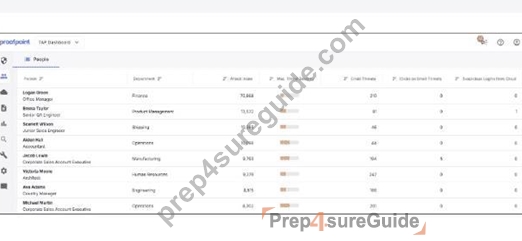
which user would most benefit from attending security awareness training based on their behavior?
- A. Logan Green
- B. Scarlett Wilson
- C. Emma Taylor
- D. Jacob Lewis
Answer: D
Explanation:
In Proofpoint user-risk views (People page / user lists), "behavior" signals that drive training prioritization typically include measurable interaction with threats-especially clicks on email threats and repeated exposure patterns. The exhibit indicates that Jacob Lewis stands out behaviorally (e.g., elevated "Clicks on Email Threats" relative to peers and/or meaningful exposure indicators), making them the best candidate for targeted awareness intervention. From an IR preparation standpoint, training is most effective when it is risk- based and individualized: users who click are statistically more likely to become the initial foothold for credential theft and account takeover. Proofpoint programs commonly combine technical controls (URL Defense blocking, attachment detonation, post-delivery quarantine) with human controls (just-in-time coaching, targeted modules, reinforcement after real-world reports). Assigning training to high-click users reduces future incident volume by cutting successful phishing rates, improving reporting via "Report Suspicious," and increasing early detection. Operationally, analysts also pair training with compensating controls for repeat clickers (stricter URL access policy, heightened monitoring, enforced MFA, mailbox rule audits) to reduce risk while behavior improves.
NEW QUESTION # 24
Which of the following is an item that should be included in an incident report as part of the post-incident debrief?
- A. Incident response plan
- B. Adversary tactics and techniques
- C. Network diagrams
- D. Proofpoint threat landscape reporting
Answer: B
Explanation:
A high-quality incident report captures what the adversary did in a way that enables prevention and detection improvements. Including adversary tactics and techniques (C) is essential because it translates raw artifacts (emails, URLs, headers, click events) into actionable security engineering outcomes: which initial access method was used (credential phishing vs BEC), which impersonation technique (display name, lookalike domain, supplier compromise), what persistence was attempted (mailbox rules/forwarding, OAuth consent), and what objectives were pursued (invoice fraud, data theft, lateral phishing). In Proofpoint-centered IR, mapping tactics and techniques supports targeted control tuning: URL Defense policy, attachment sandboxing, impostor rules, DMARC enforcement, and TRAP automation; it also improves analyst playbooks (what pivots to run next time, what indicators to hunt). The incident response plan (B) is a reference document, not an incident-specific report item. Network diagrams (A) may be helpful in some incidents but are not always relevant for email-led events. Threat landscape reporting (D) is contextual intel, but the report must focus on what occurred in this incident and what to change to reduce recurrence, which is best captured via tactics/techniques.
NEW QUESTION # 25
Which activity is part of the Preparation phase in the NIST lifecycle?
- A. Documenting postmortem reports.
- B. Conducting response drill scenarios.
- C. Identifying compromised accounts.
- D. Restoring systems from backups.
Answer: B
Explanation:
Preparation is the phase where organizations build readiness before incidents occur-people, process, and technology. Conducting response drill scenarios (D), such as tabletop exercises or simulation drills, is a core preparation activity because it validates playbooks, escalation paths, tooling access, and decision-making under time pressure. In Proofpoint-focused IR, drills commonly simulate credential phishing leading to account takeover, or BEC invoice fraud, requiring coordinated actions across TAP triage, Smart Search message tracing, TRAP post-delivery pulls, IAM containment (password reset/token revocation/MFA enforcement), and business verification procedures. The goal is to ensure responders can execute quickly and consistently, and to discover gaps such as missing log retention, unclear ownership for blocklists, or untested comms templates. Restoring from backups (A) is recovery, documenting postmortems (B) is post-incident activity, and identifying compromised accounts (C) is detection/analysis. In practice, preparation drills measurably reduce mean-time-to-contain by ensuring analysts already know where to find Proofpoint evidence (headers, verdicts, click telemetry) and how to trigger remediation workflows without delay.
NEW QUESTION # 26
......
Proofpoint PPAN01 Exam Syllabus Topics:
| Topic | Details |
|---|---|
| Topic 1 |
|
| Topic 2 |
|
| Topic 3 |
|
| Topic 4 |
|
| Topic 5 |
|
LATEST PPAN01 Exam Practice Material: https://www.prep4sureguide.com/PPAN01-prep4sure-exam-guide.html
The Realest Study Materials PPAN01 Dumps: https://drive.google.com/open?id=1DlXxXV6wWTVHOm7bTvN1Ytop-V988Xav